

By Bernadette O’Farrell
Each journey I lead is shaped entirely by the women who join it. What follows are the defining moments of October 2025, not everything, but what shaped the journey. Eighteen days. Five women. No standard itinerary.
These are not journeys for travellers who want to cover ground quickly. They are for women who want to understand what they are looking at, not simply add it to a list of places visited. The goal is not to see India. It is to understand it.
Understanding comes through the workshops we visit, and the conversations they open up. Sitting with embroiderers in Jodhpur or weavers and block printers in the villages around Jaipur, long enough for something to shift, not just in what you know about the textile, but in how you see the place and the people within it. Craft is the way in. What opens up is the whole.
The five women who joined me last October were not casual travellers with a passing interest in Indian craft. Between them, they had studied textile design at Chelsea School of Art, completed courses at the V&A, spent decades as embroiderers and quilters, and two were guides themselves. All had a serious interest in history. I mention this not to flatter them, but because it shaped everything, the workshops we chose, the depth of conversation in the ateliers, the questions the artisans were asked that they rarely get asked.
When I design a journey, I design it for the specific women who are coming. This one was built around hands-on learning, technical immersion: block printing in Bagru and Pipar, time in weaving villages, access to ateliers and collections not usually open to visitors, and conversations with makers.
The group had a serious interest in textiles, including embroidery, hand printing and natural dyes, but also a strong curiosity about history and culture, and a desire to experience and absorb India’s heritage more fully. Alongside this, they wanted to see the key temples, forts and palaces. The journey moved between cities and quieter rural settings, with a deliberate variation of pace. There was time spent in villages, with a high level of engagement with the communities we visited.
They also wanted to enjoy where they stayed, with good food, the possibility of swimming, and places to rest between visits, so the choice of hotels reflected that balance.
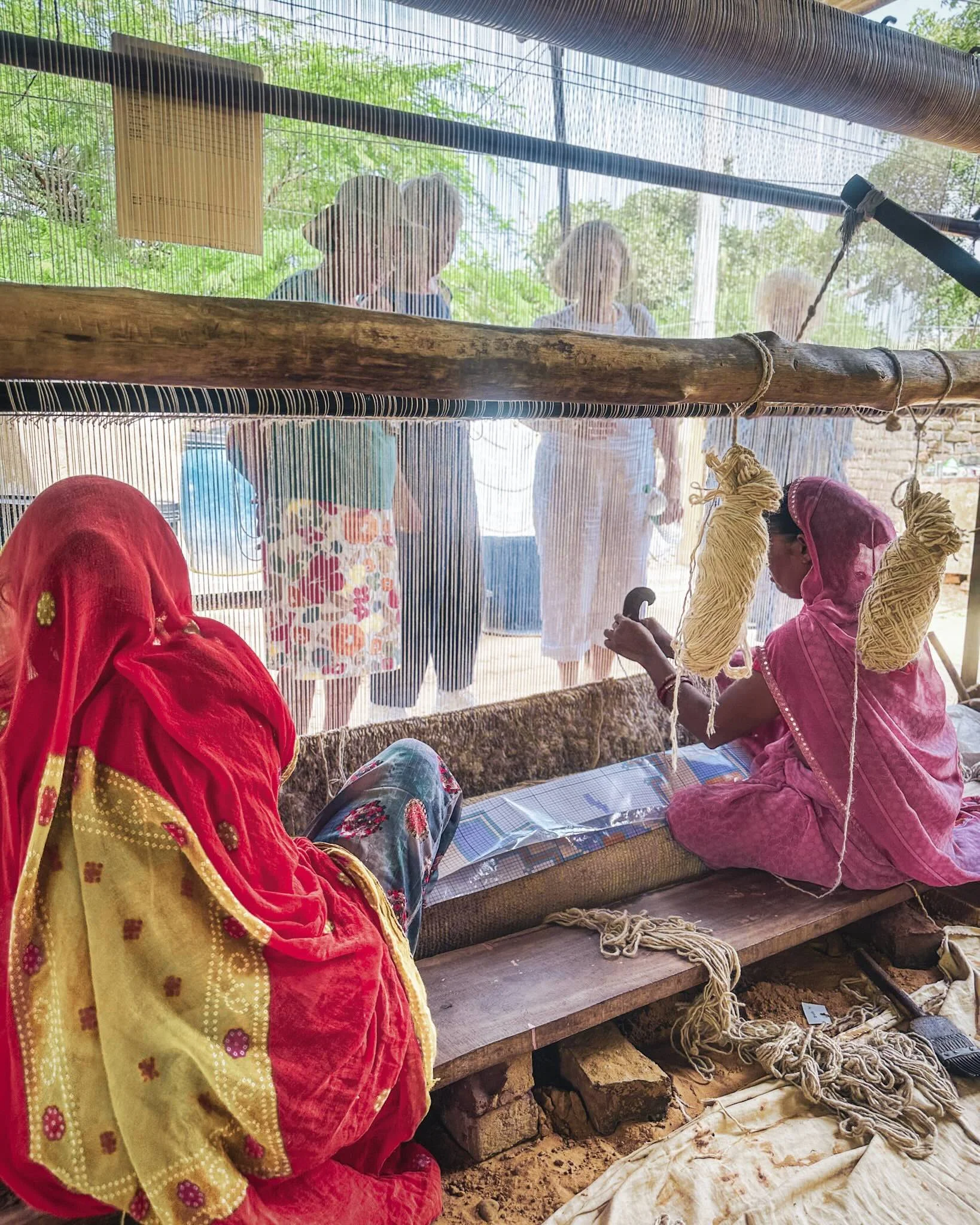
Weavers at the loom, the group watching from the other side. Jaipur Rugs, Rajasthan.
Delhi: The Foundation
We stayed at Bungalow 99 in Defence Colony, a beautifully designed property with two floors between us, three bedrooms on each, and a calm considered interior. Defence Colony is leafy, relatively quiet, close to markets and parks. It is not the Delhi of the guidebooks, which is exactly why it works.
On the afternoon of arrival, I expected everyone to sleep. Instead, all five wanted to go out. We went to Humayun’s Tomb, the UNESCO-listed Mughal masterpiece set within chaharbagh gardens of extraordinary calm. The symmetry, the stillness, the sheer beauty of it after the intensity of the journey in: it was exactly the right place to begin.
The next morning we went to Old Delhi with Street Connections, the organisation founded by Nick Thompson, who trains former street children as guides, providing fair wages, dignity and sustainable futures. Our guide, who had lived and worked these lanes as a child, showed us the old city in a way no textbook can replicate.
We moved through the tangled alleyways by cycle rickshaw and on foot, past century-old traders, embroidered trims and buttons used to decorate saris and wedding garments, tiny workshops hidden behind unmarked doors. We stopped at Gulab Singh, a family perfumery over two hundred years old. I have been coming here for years;I buy my perfumes here, and the surrounding embroidered trim shops are extraodinary.
Lunch was at Hotel Dharampura, a beautifully restored 200-year-old haveli serving authentic Mughal dishes alongside classic street food.
The following day we went on what I think of as the Pashmina Trail. Kashmir shawls, woven from the finest fibre of the Himalayan Changthangi goat and enriched with intricate sozni embroidery or kani weaving, are among the most technically demanding textiles in the world, and I am completely obsessed by them. We began at Kashmir Loom, founded by textile scholar Jenny Housego, formerly a curator at the V&A and the Textile Museum in Washington. Her team gave us a guided introduction to the history and technique behind these extraordinary pieces. The women were enraptured, and several bought shawls.
Some then went on to Shaw Brothers for its remarkable private collection of antique shawls; others went to the National Crafts Museum, one of the largest craft museums in India and, for a textile lover, one of the most rewarding places in the country. The museum’s textile gallery holds over two hundred types, displayed with serious scholarly attention to technique, region and historical context. It is not a passive experience. You read India through cloth here, through ikat and bandhani, jamdani and zardozi, Kutch mirror work and Phulkari from Punjab. Living artisans work on-site. The museum was designed as a place of practice, not only preservation.
Dinner that evening was at the Imperial Hotel, one of the great colonial interiors of Delhi, with an exceptional art collection throughout and a very fine kitchen.
Fort Kesroli: Breathing Space
We left Delhi with our driver Krishna, who has driven me and my groups safely across Rajasthan for over a decade. Fort Kesroli, a fourteenth-century heritage fort set in a village, one of India’s oldest heritage hotel sites, was our first overnight stop.
There was a pool, there were excellent massages, and in the early evening an optional walk through the village itself: women cooking on open fires, preparing pickles, families going about the rhythms of rural life. The women of Kesroli village have greeted me as an old friend for years now, and they welcomed the group with the same warmth. It is a quiet place, which after Delhi is exactly what the body needs.
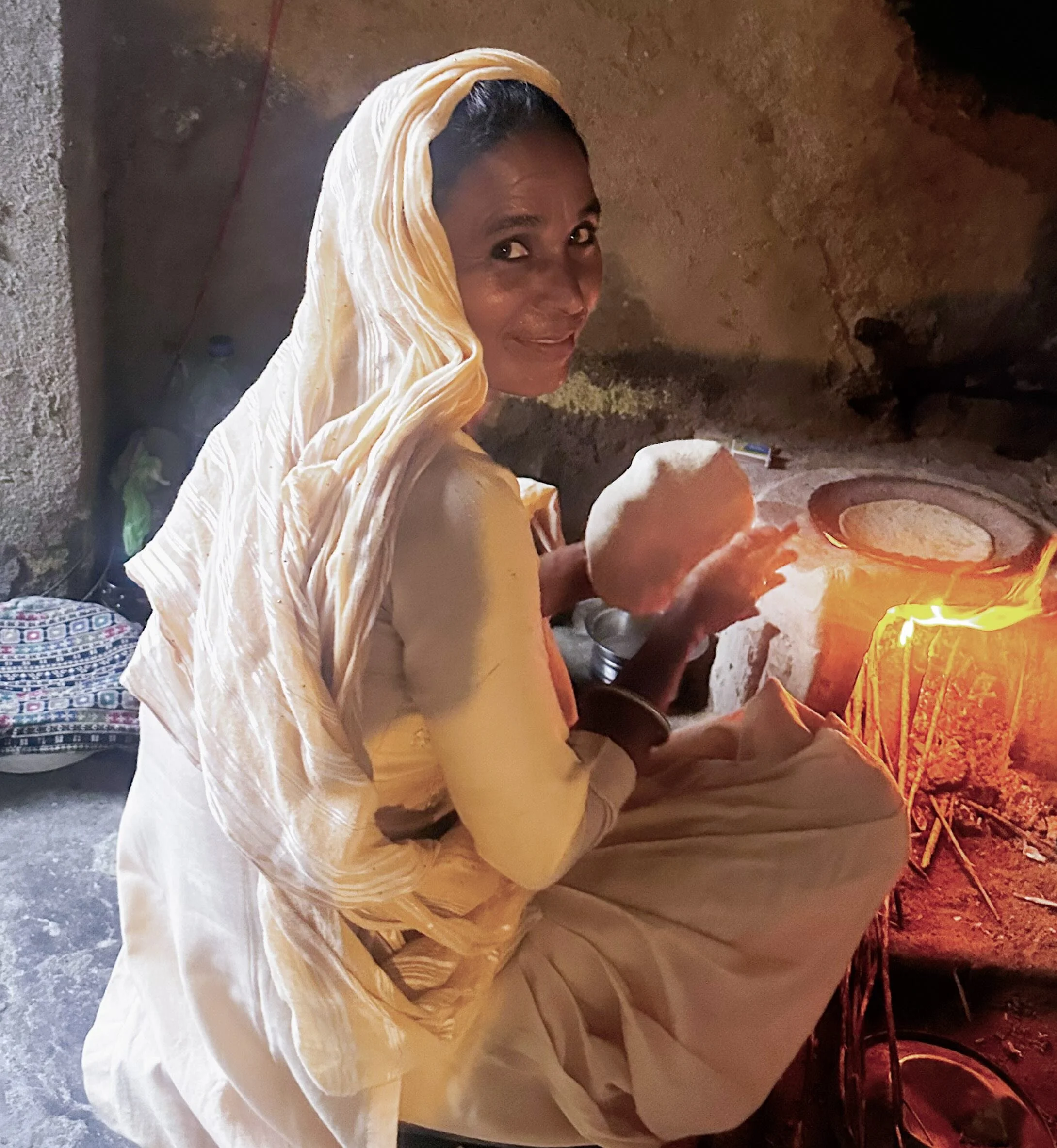
A woman making chapatis over an open fire during the Kesroli village walk, Rajasthan.
Outside Jaipur: Workshop and Wilderness
We arrived at a boutique homestead, Artisav House, just outside Jaipur, a property created by Japanese designer Yuka, who fuses Indian craft with Japanese sensibility. Block prints, embroidery, artisan details throughout. Views to the Aravalli Hills and the fort beyond. Occasional leopard in the green ridgeline at dusk. The chef Surrinder has cooked for me for years and his food is exceptional.
The next morning, Yuka gave a short introduction to Indian textiles and then led a hands-on workshop in handwork buttonhole embroidery, a traditional technique of delicate precision that is far harder than it looks. The women brought their own shirts and worked on handwork buttons and buttonholes. These were women who had studied design in London. What they produced was remarkable, and the exchange was genuine, two different traditions of craft knowledge meeting across the same workbench.
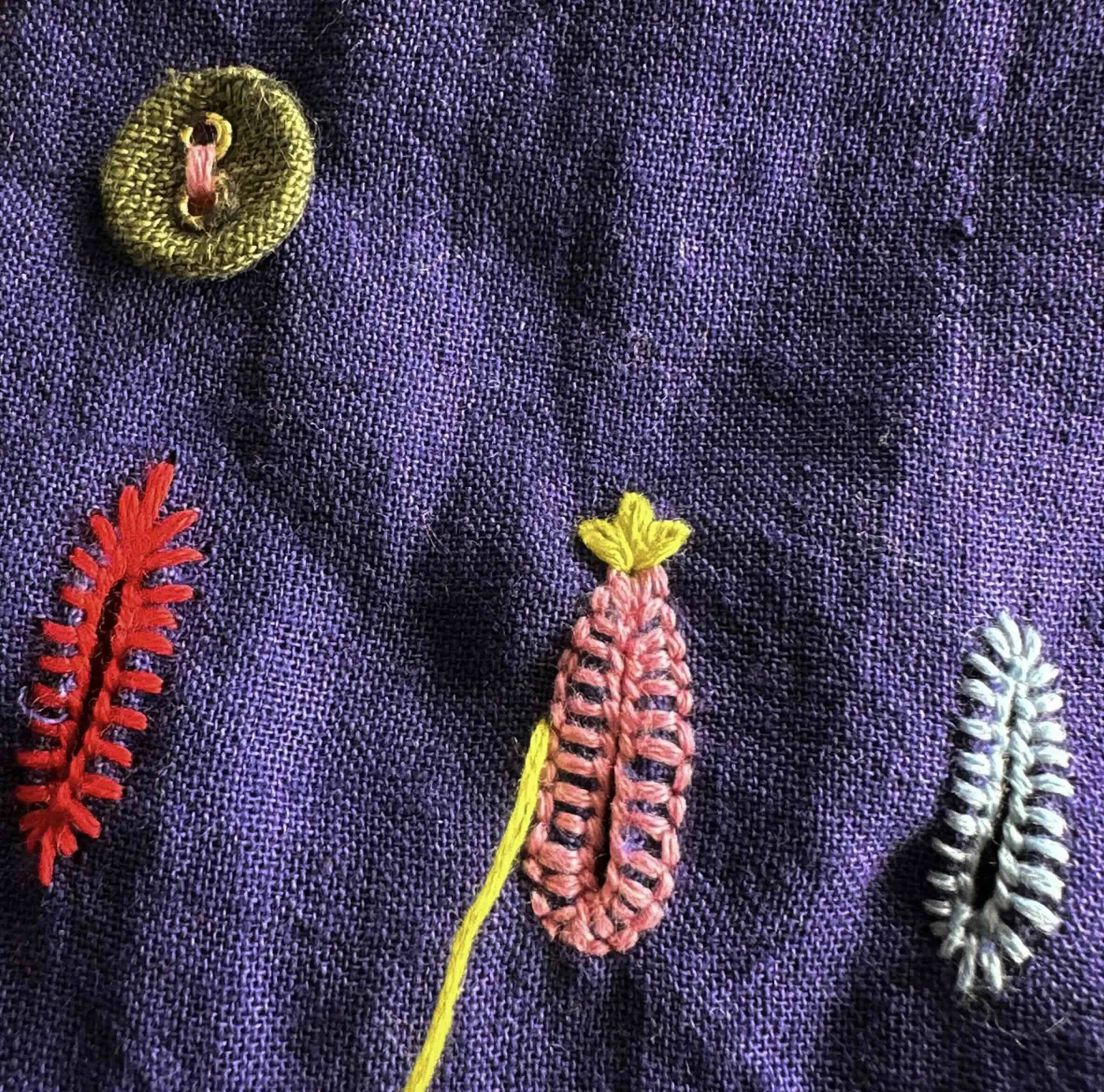
Learning buttonhole and button embroidery at Artisav guesthouse, Jaipur.
Yuka also had a small shop within the guesthouse, displaying her own collection of artisan-made clothes and accessories. It was hard to leave without something. I found myself drawn to the tunics and the handwoven Bengal towels. Few of us left empty-handed..
That evening we drove to Dera Amer, a wilderness camp at the foot of the Aravalli Hills. We walked through the forest at dusk with a rescued elephant and his mahout, then sat down to a private bonfire dinner under the stars. There are moments on these journeys that are very hard to put into language. This was one of them.
Jaipur: The City in Depth
Nila House, the restored 1940s building founded by Lady Caroline Bamford as a centre for sustainable textiles and craft, was our base for a full day’s workshop with Kalbelia women, learning Gudri quilting. Gudri is a form of patchwork quilting from Rajasthan, dense and tactile, each piece built from layers of salvaged cloth. The Kalbelia community are known for their embroidery; their Gudri work is exceptional. The afternoon offered more shopping in Nila House’s own collection, which is very difficult to leave empty-handed.
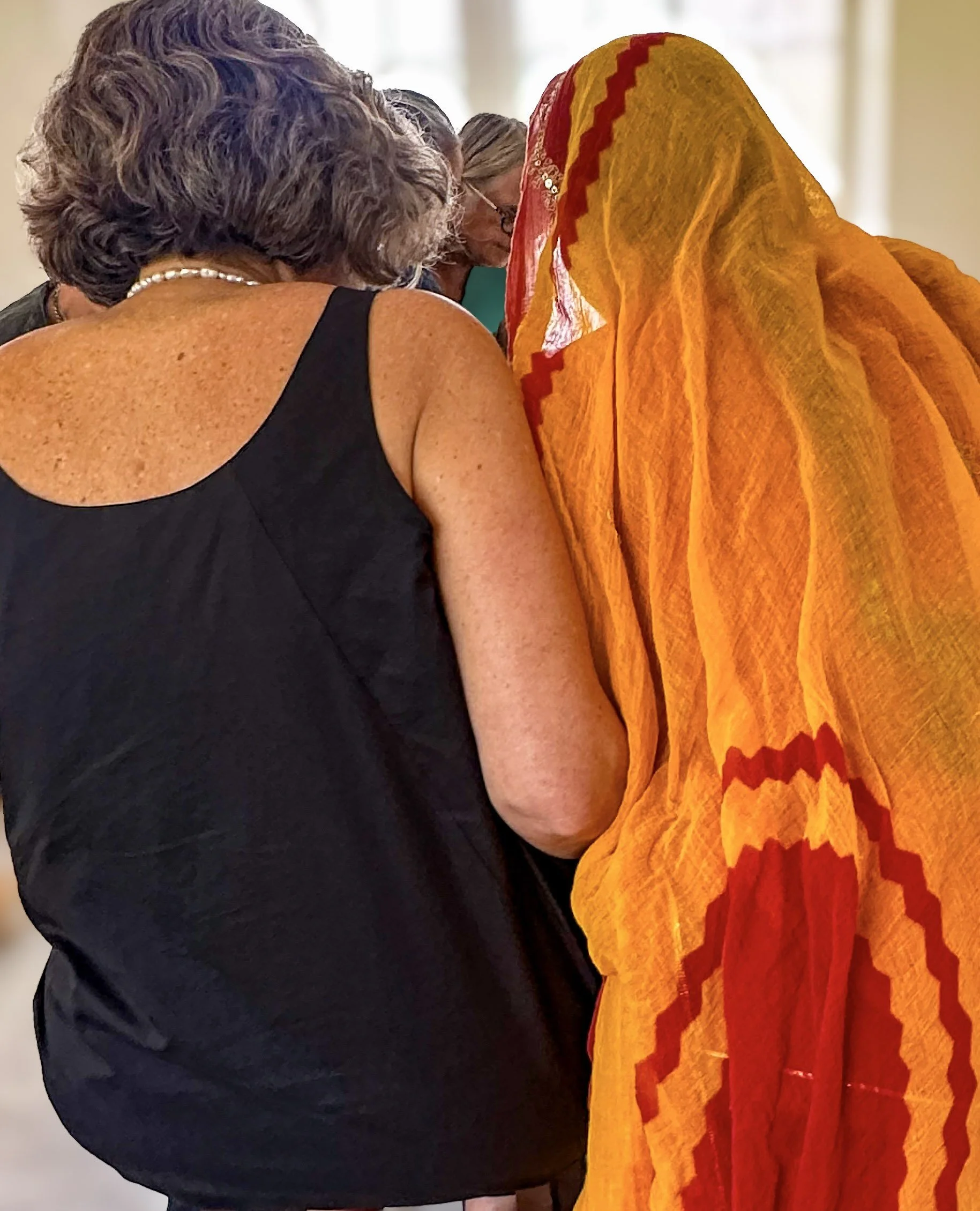
Heads together over the work. A gudri quilting workshop with Kalbelia women at Nila House, Jaipur.
We visited the City Palace on a VIP tour, the living monument to Rajput and Mughal design with its painted gateways, richly decorated halls and extraordinary textile collection: embroidered court garments, opulent silks, turbans and robes. The private rooms of the current Maharaja are among the most extraordinary interiors I have seen anywhere, including the astonishing blue room.
The Palace also houses inspiring contemporary boutiques where the tradition continues to shape what is being made now.
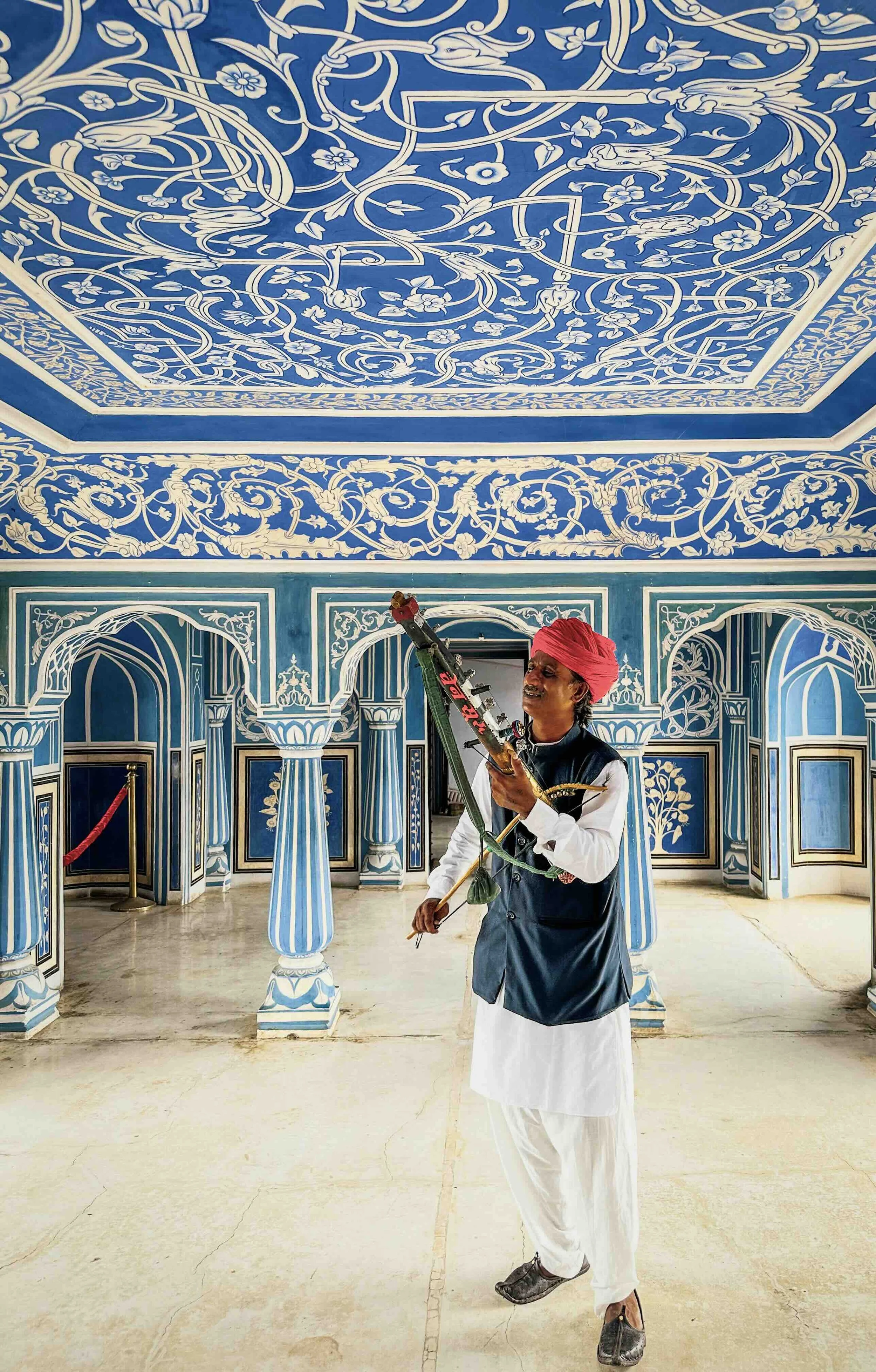
A musician playing a traditional bowed string instrument in the painted rooms of the City Palace, Jaipur.
The next day took us to Manpura, the village initiative run by Jaipur Rugs, where Rajasthan village artisans keep the centuries-old tradition of hand-knotted rug weaving alive. We stepped into weavers’ homes, watched yarn being spun, dyed and worked into rugs that carry personal stories in their patterns.
Two of our group knew how to weave. They sat down with the women and joined in. The welcome was immediate. We had lunch there, simple, delicious and then went on to the Jaipur Rugs showroom to see the finished work and spent time talking with the founder, NK Chaudhary, who is one of the most interesting people you will meet in the craft world.
Jaipur Rugs operates on a different model to many of the artisan communities we visited. The weavers are part of a larger organisation, producing work for an international market.
What is interesting is how that structure is being adapted. Through the Manpura initiative, village weavers are encouraged to design their own rugs, drawing on local motifs and narratives rather than working solely to external briefs. Some of these pieces have gained international recognition, and the weavers share in the profits.
It is a more complex model, not independent, but not entirely directed either, and one that raises questions about authorship, creativity and scale. NK Chaudhary speaks about it with conviction, and I found the conversation both thoughtful and provocative.
Late afternoon tea at Rambagh Palace, once the residence of the Maharaja of Jaipur, now a grand heritage hotel set within forty-seven acres of Mughal garden. Silk drapes, hand-carved stone, jali screens, and a very grand tea.
It is a different register, but part of the same story. The patronage that once sustained the crafts still echoes here. These are worlds that do not often meet, but they are bound together by history, each shaping what the other became.
Dinner one evening at Bar Palladio, the iconic Jaipur restaurant with its peacock-blue interiors, hand-painted floral murals and Mughal-Venetian design. Lanterns in the garden. Peacocks in the mango trees.
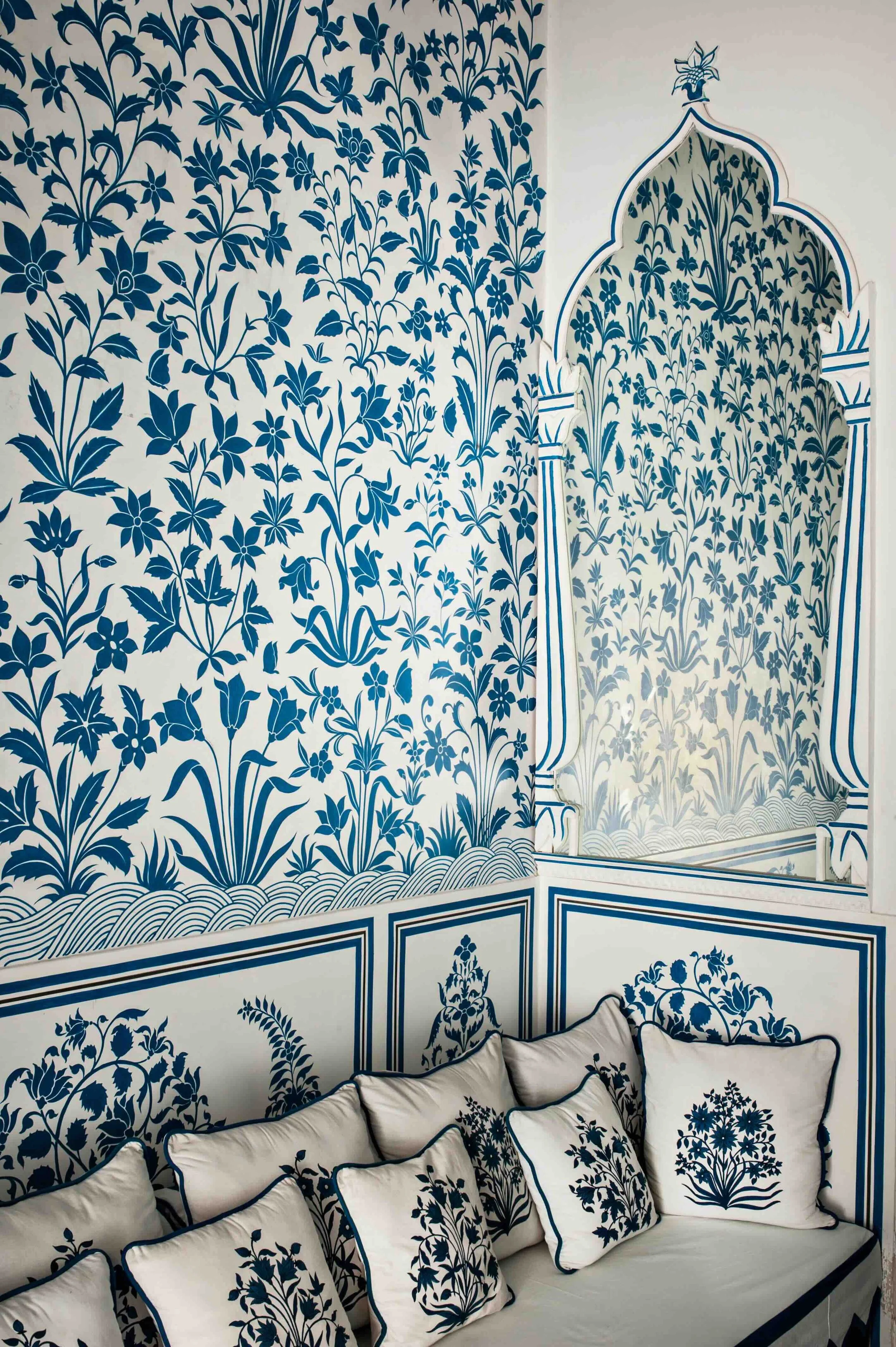
The painted interior of Bar Palladio, Jaipur.
Bagru: The Printing Village
This was, for many of the group, a highlight of the journey. Bagru, a village outside Jaipur, is the home of the Chhipa community of hand block printers, masters of a tradition that has been passed down for generations. We arrived early, in time to see the rhythms of the morning: women washing lengths of fabric, laying them in long runs across the grass to dry, men carving wooden blocks, yards of freshly printed cloth drying in the sun.
We watched the natural dye preparation: indigo, flowers, jaggery, plant-based and mineral pigments that give Bagru its characteristic palette of earth reds, soft ochres and deep blues.
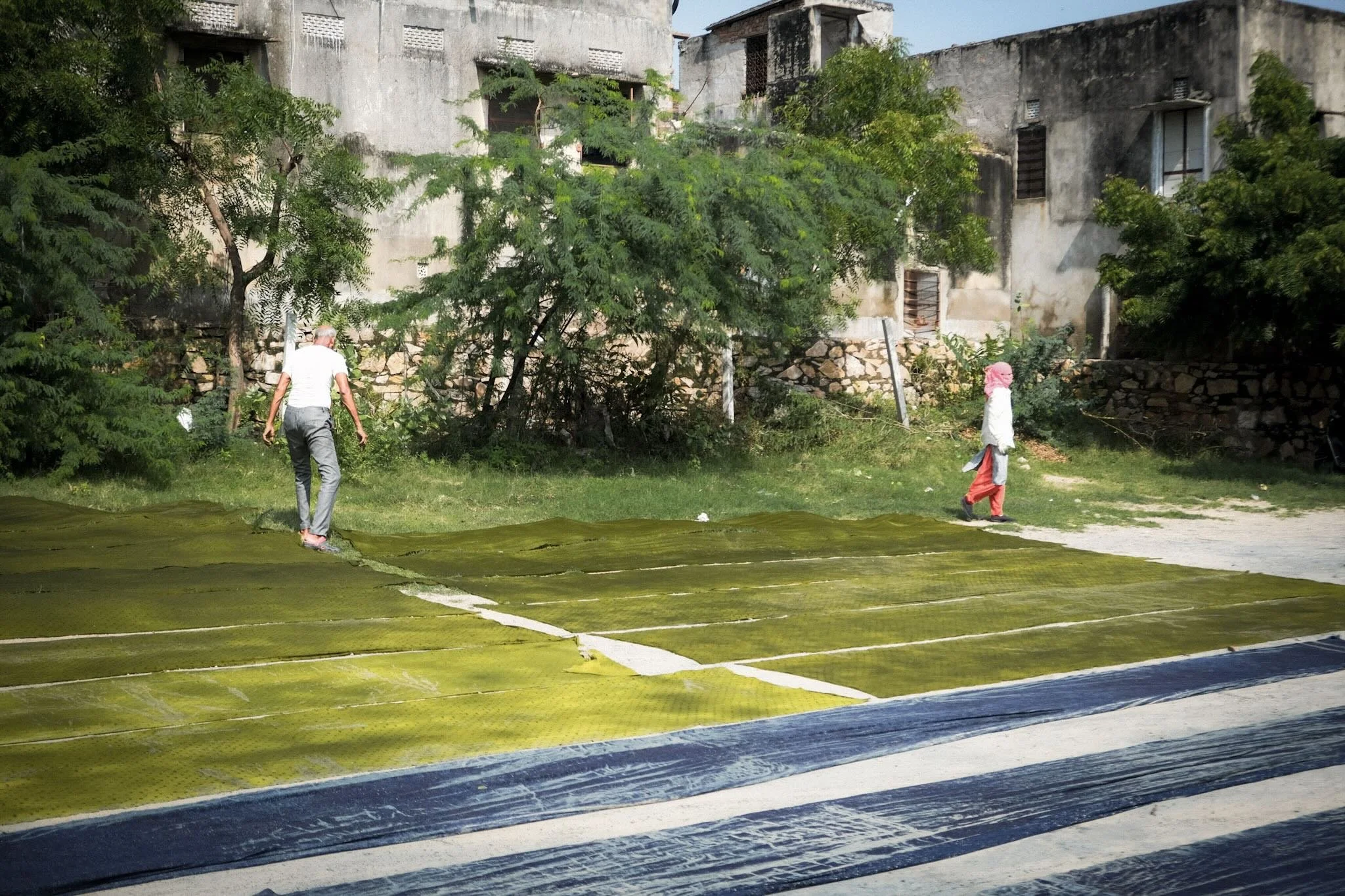
Resist-dyed cloth drying in the sun at Bagru, Rajasthan. The green and indigo are characteristic of the village’s natural dye traditions.
We learned about dabu printing, the process in which a mud resist made from clay, lime and natural gum is hand-stamped onto fabric before dyeing to create layered resist patterns.
We visited several workshops. Then the group attended their own workshop, guided step by step by the Chhipa artisans, and block printed their own scarves.
Here is what I did not expect: these women, schooled in London design studios and museum textile departments, produced scarves of remarkable quality. Their pattern sense was instinctive. The artisans were visibly pleased, not in the polite way that comes with any visitor, but in the way that happens when someone on the other side of the table clearly understands what you are doing. It was one of those exchanges that I hold onto, because it does not always happen.
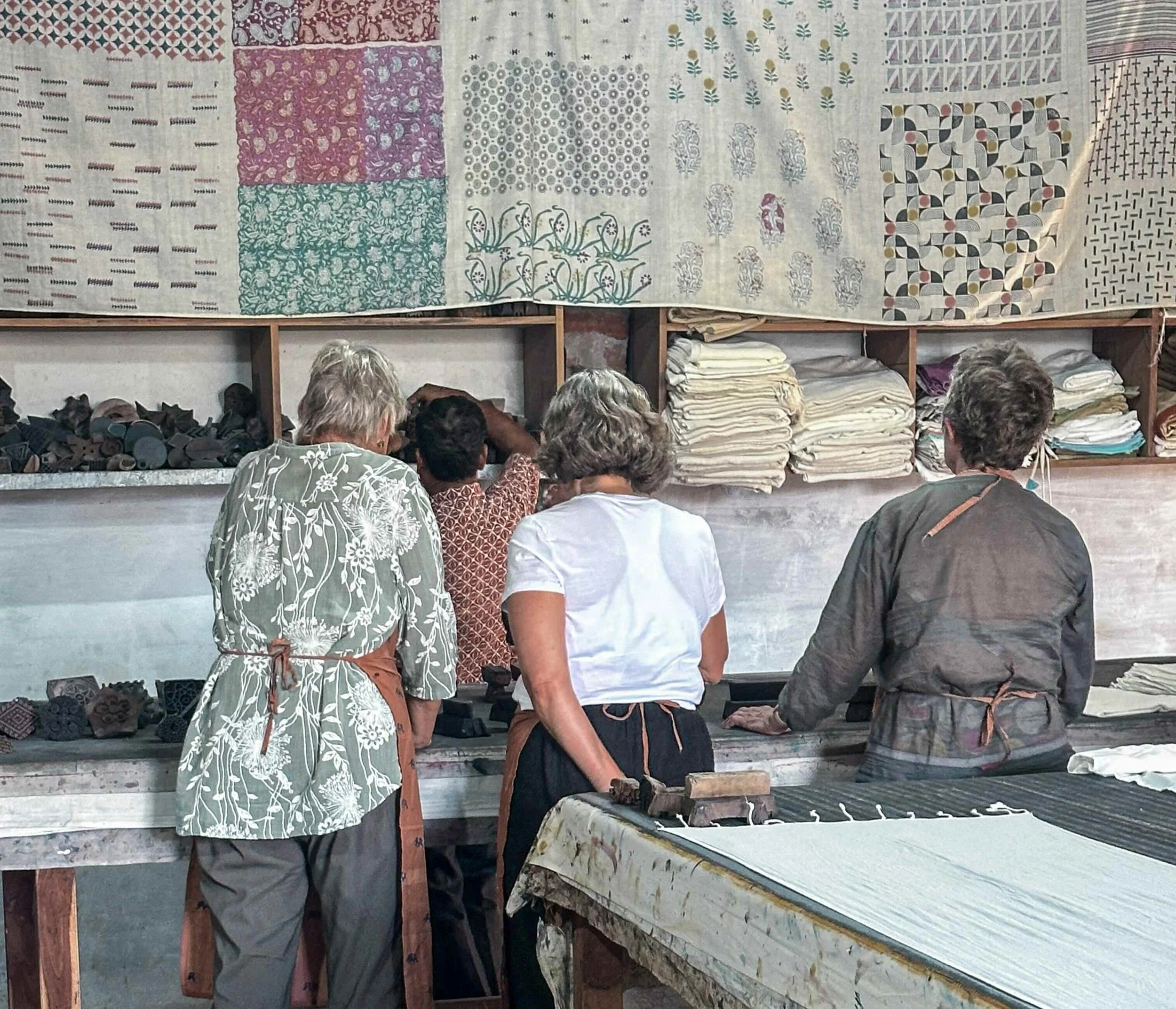
Choosing printing blocks at Studio Bagru.
Chandelao Garh and Sunder Rang
Chandelao Garh is a 300-year-old heritage haveli in the countryside, home of the Singh family and now run by Thakur Pradyuman Singh. It has no intention of being a five-star resort. Its stone walls, carved arches and shaded courtyards are the experience, and what makes it exceptional is the model of sustainable tourism it practises: profits reinvested in the village, girls’ education funded, digital literacy classes running, the Sunder Rang arts and craft project sustaining employment for village women. Solar power. Rainwater harvesting. Hundreds of trees planted.
The next morning we walked to Sunder Rang, the women’s cooperative from the surrounding village, where traditional embroidery, patchwork and block printing are practised, taught and passed on. We met the women, watched them work, and joined a workshop to learn some of their techniques.
There was a great deal of mutual exchange. These are highly skilled women on both sides of the encounter, and the conversation between them, conducted largely without a shared language, was entirely clear.
The afternoon was spent at the pool, with an optional evening jeep safari or village walk. The group chose the walk: meeting children, watching women cook, stepping quietly into the daily life of a Rajasthan village.
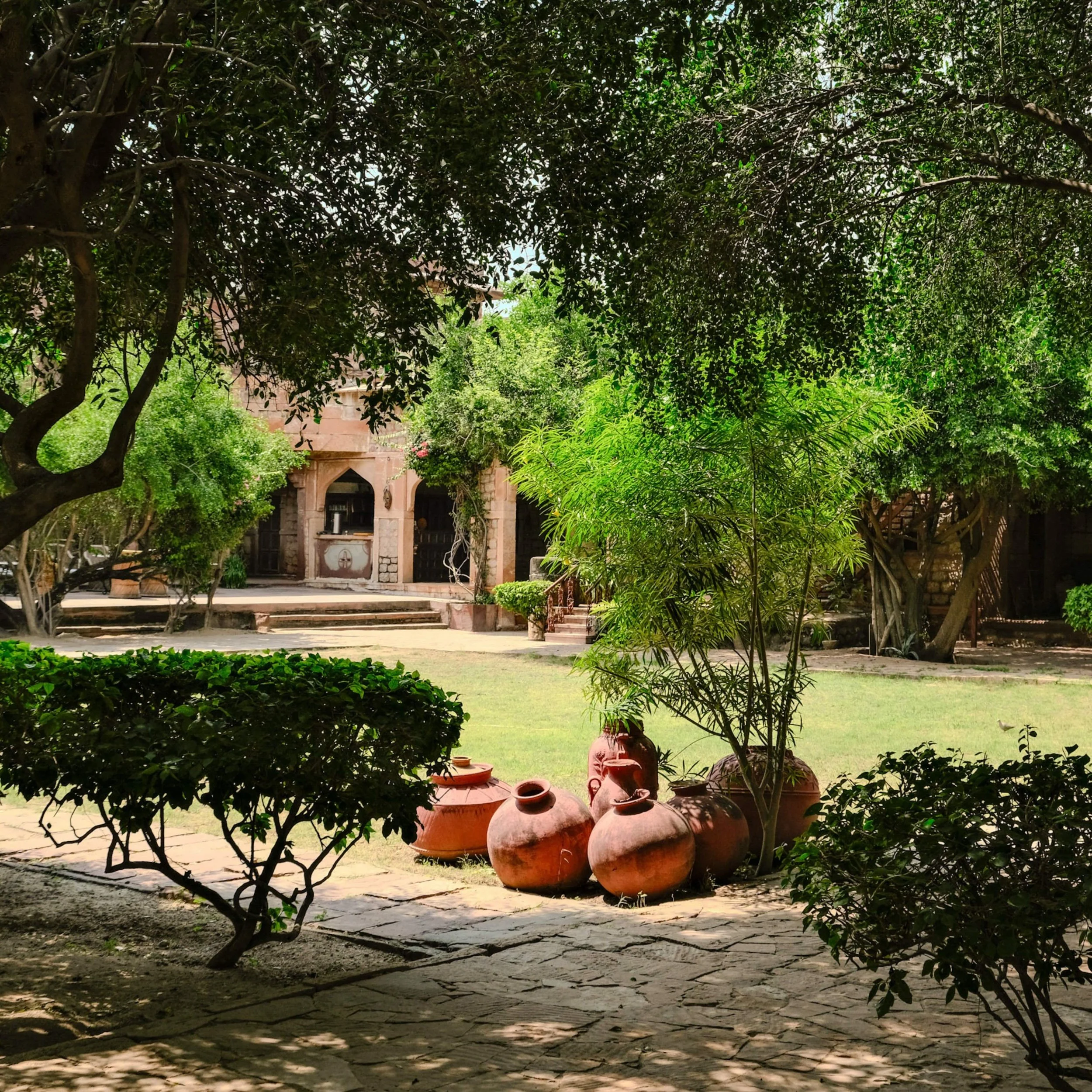
The courtyard garden at Chandelao Garh: sandstone archways, terracotta vessels and deep shade in the heart of rural Rajasthan.
Pipar and Jodhpur
Pipar is a bustling market town known for its block printing traditions, and for the workshop of Chhipa Yasin Shahabuddin and his colleagues. The process here differs subtly from Bagru. Resist is applied by hand using a clay-based paste, and then dusted with sawdust to hold the pattern in place before the cloth meets the dye. Indigo, wooden blocks, rows of drying fabric, the rhythm of repetition.
Everything happens within a single compound. Dyeing, washing, drying, printing, finishing. You move through it step by step, seeing the entire process unfold in one place. It gives a clarity that is rare.
The workshop feels almost outside time. It is easy to imagine it much as it was generations ago, and yet the work produced here travels far beyond Pipar, carried into an international market through designs made with natural dyes.
The women followed the full process, watching resist patterns emerge slowly from the indigo.
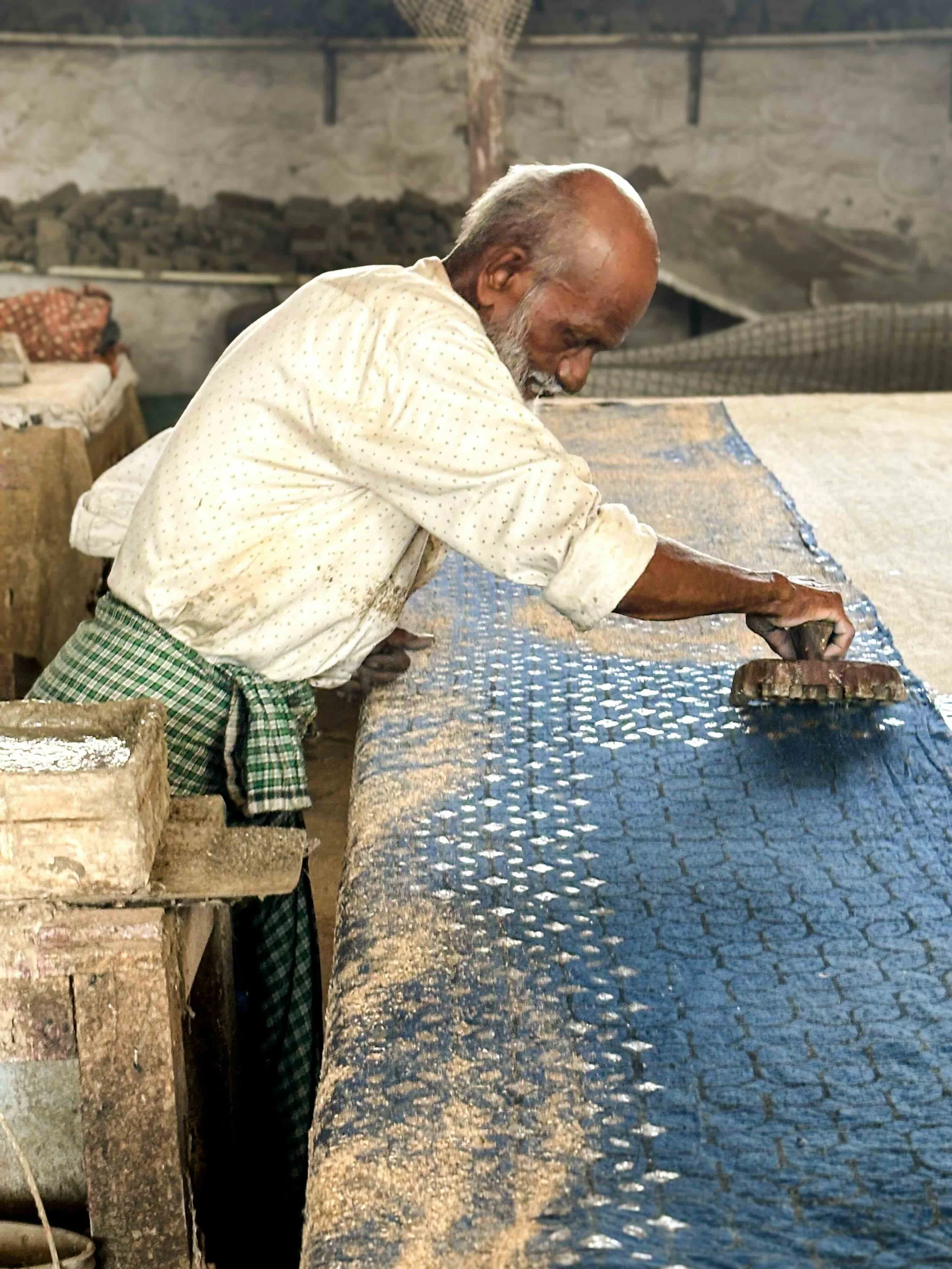
Block printing at Pipar: sawdust pressed into the wet mud resist, binding and sealing each repeat before the cloth meets the dye.
From Pipar we went on to Sukh Sagar Haveli on the edge of Jodhpur. A restored nineteenth-century property set in leafy grounds, transformed by Canadian interior designer and textile curator, Cathy Blundell into her home and a deeply considered boutique stay. Vintage textiles, handcraft throughout, and food from the garden prepared by her Nepalese chef, some of the best cooking I have encountered in India.
We spent a few afternoons here doing very little; swimming, reading, wandering the grounds and the surrounding countryside. After the intensity of the workshops and the villages, it was exactly what was needed.
We spent a day in Jodhpur’s blue city with Himanshu, a fifth-generation resident who knows not only its streets but the lives within them. To walk with him is to move beyond the surface, into homes, conversations, and a way of seeing the city that would otherwise remain closed. He took us into his own family home for a traditional breakfast cooked by his mother.
We visited Mehrangarh Fort, the fifteenth-century citadel rising from the rock above the city, described by Rudyard Kipling as “ the work of giants”. Inside, carved stone, mirror work and painted panels are among the finest in Rajasthan, with views across the indigo city stretching far below.
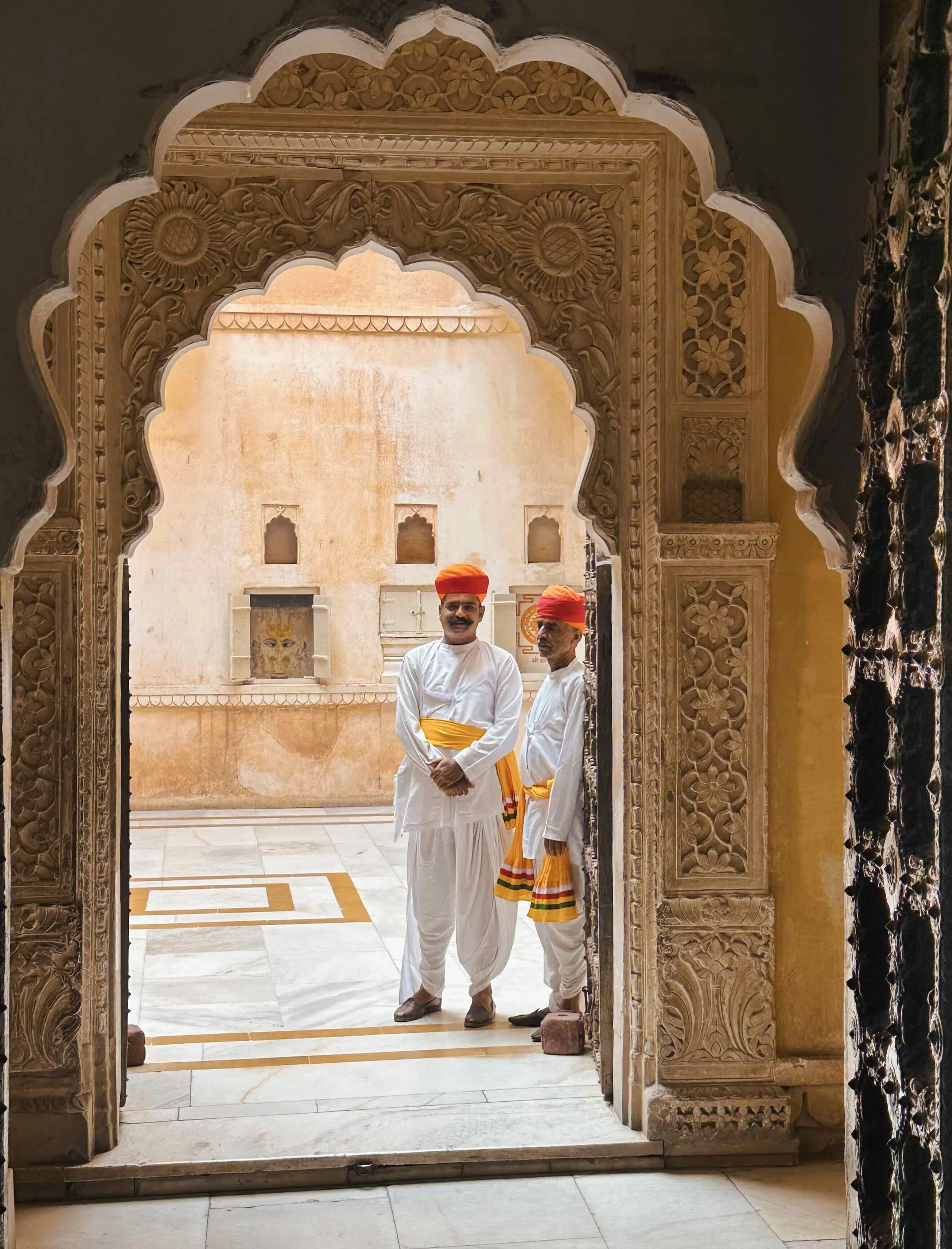
Inside Mehrangarh: two attendants framed by a scalloped sandstone arch, the fort’s inner courtyard glowing behind them.
And then, on one of the last afternoons, we went to a place I think of as a well-kept textile source in Jodhpur. A large emporium drawing from across Rajasthan and Kutch, with an extensive collection that extends beyond textiles to antique furniture, marble and objects gathered from across the region. The quality is consistently high, the textiles particularly fine.
It operates differently to the artisan workshops we had visited. This is not direct from the maker, but part of a wider network through which craft moves into the international market. Both have their place, and it is useful to understand the distinction.
Those who had claimed at the beginning of the journey that they were not interested in shopping found themselves reconsidering. Much of what they chose was sent home.
Not far from there, and quite by accident, I was taken to a very different kind of workshop. A single carpet weaver working with his wife, producing rugs entirely by hand. No signage, no visitors, nothing to suggest it exists beyond word of mouth. The work was quiet, precise, and beautiful. It is unlikely you would find it without being shown.
Each October journey is different, shaped by the people who come. If you are interested in something similar, built around your own interests and pace, I am always happy to talk.
Bernadette O’Farrell has spent thirty years working with artisan communities primarily in Rajasthan and Kerala. She leads small-group cultural and textile journeys for women through India, under India with Bernadette.