

By Bernadette O’Farrell
There are places in India where craft is still part of everyday life. Where skills are passed down through families, and what you are seeing has been practised and refined over generations.
Ajrakhpur, on the outskirts of Bhuj in Kutch, is one of those places.
I was brought here by Kuldip Gadhvi of United Artisans of Kutch. He knows this landscape and its makers exceptionally well, and has worked closely with many of the artisans here over the years. He joins us in Kutch, bringing long-standing relationships with the artisans and a deep understanding of the region.
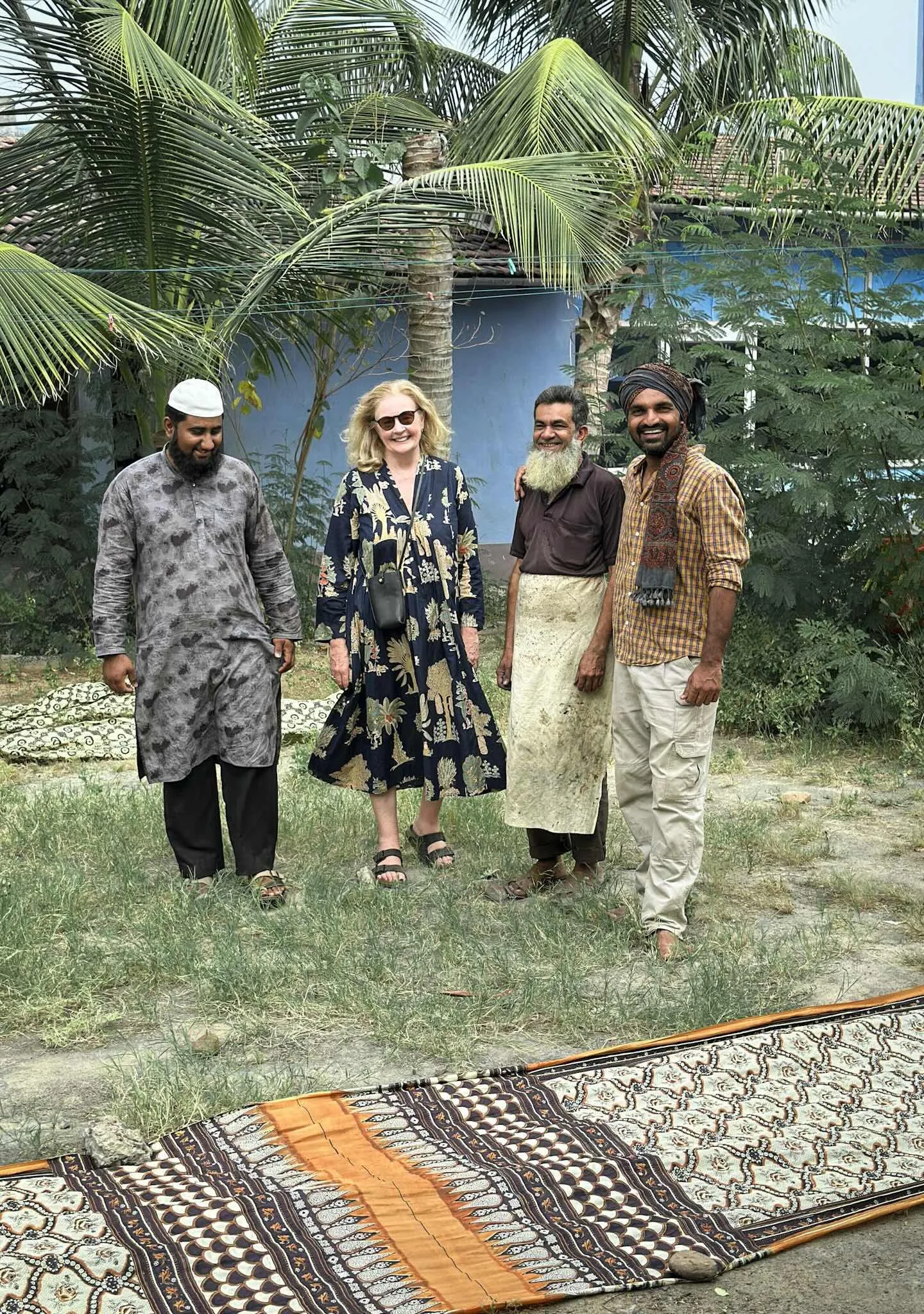
With Faizan Khatri, Rafiq Khatri and Kuldip Gadhvi from United Artisans of Kutch. Ajrakh cloth laid out to dry in Ajrakhpur.
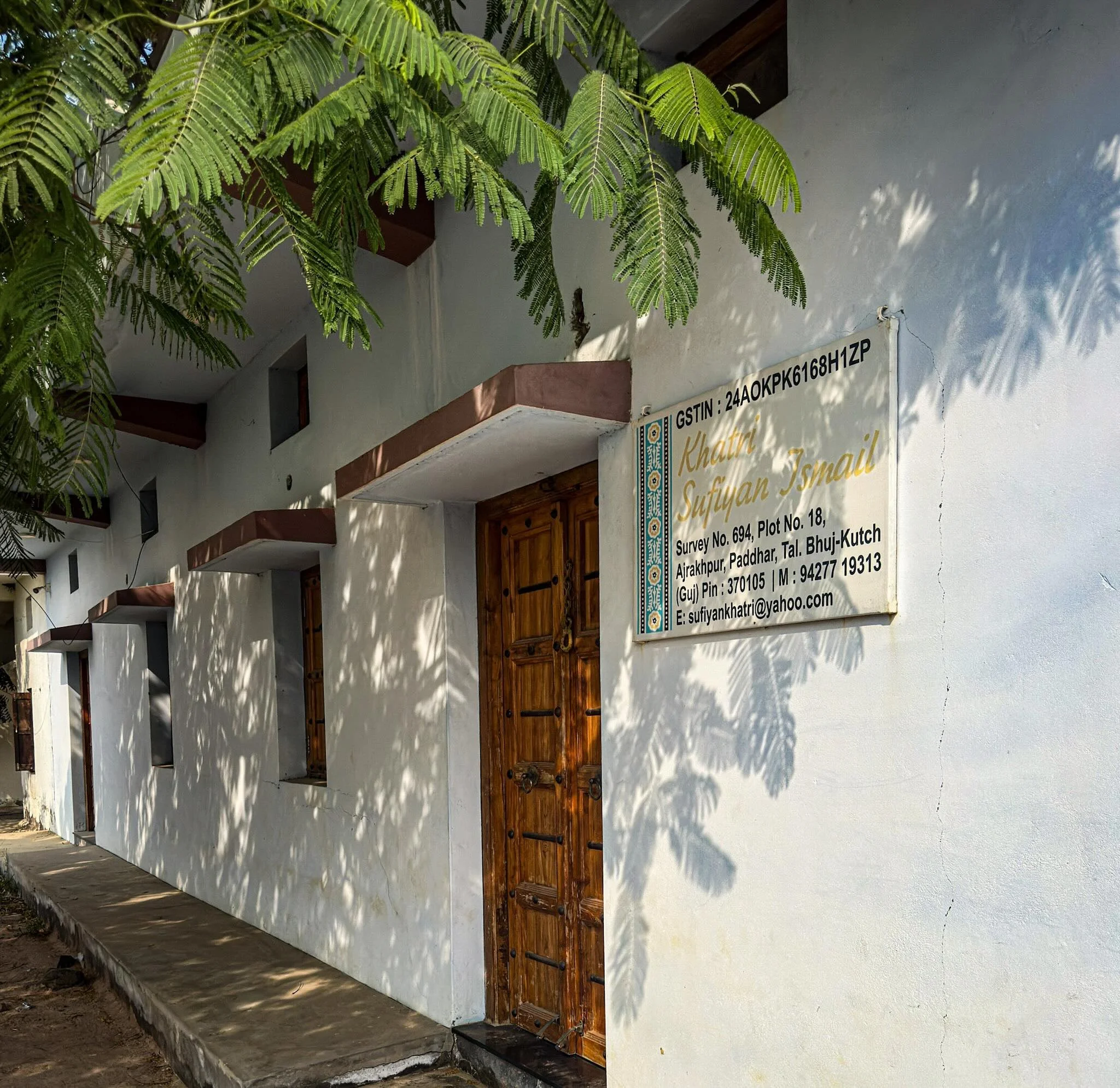
Khatri Sufiyan Ismail’s workshop, Ajrakhpur, the kind of place you might walk past and then turn back to look at again.
I arrived knowing relatively little about Ajrakh. I had heard of it and seen it, but I had never watched it being made. That is, I think, exactly the right way to encounter a place like this, with curiosity rather than expertise.
I came away wanting to know considerably more. A thousand questions, in fact.
Faizan is the grandson of Dr Ismail Mohammad Khatri, one of the most respected ajrakh masters in India, and the son of Sufiyan Ismail Khatri, who continues the family’s work in Ajrakhpur.
It was Faizan who took me, along with Kuldip, into the workshops to see the process for myself. He works alongside his father, Sufiyan Ismail Khatri, and explains everything with a depth of knowledge and an enthusiasm that is immediately clear.
A Village Built Around Craft
What struck me first was Ajrakhpur itself.
After the 2001 earthquake devastated their village of Dhamadka and made the water unsuitable for natural dyeing, many artisan families moved to this purpose-built settlement. It was not simply a relocation, but the rebuilding of a craft community around the needs of the process itself.
The result is unlike anywhere else I have visited in India. The workshops are not lined up along streets, they are scattered across open land, scrub and dust between them, no obvious order or signposting.
You simply walk, and find.
The workshops announce themselves before you reach them: the rhythmic thud of wooden blocks, the smell of dye hanging in the hot, dry air, and on the ground, threading between the scrub, trails of indigo. A path of blue staining the sand, where dye water has been carried and spilled and carried again.
The dyeing vats are outside. The washing is outside. Lengths of printed cloth laid across the earth to dry in the sun. You follow the colour, and you go in.
Each workshop I visited over the two days I spent here was distinct in scale, atmosphere and character, each one an individual expression of a shared tradition.
Moving between them felt less like a tour and more like a journey of discovery, unplanned and unhurried, genuinely exciting. But one stayed with me more than the others.
Sufiyan’s Workshop
Sufiyan Ismail Khatri’s workshop announced itself differently from the others. The building is painted that particular chalky, sun-bleached blue you find across Kutch. Softer than Jodhpur’s famous indigo cobalt, more like a colour the sky has left behind.
What set it apart, though was the trees, genuinely lush in that dry landscape, and beneath them, a scatter of vivid orange flowers I hadn’t seen anywhere else in Ajrakhpur. In a settlement of dust and scrub, it felt unexpectedly tended, almost private.
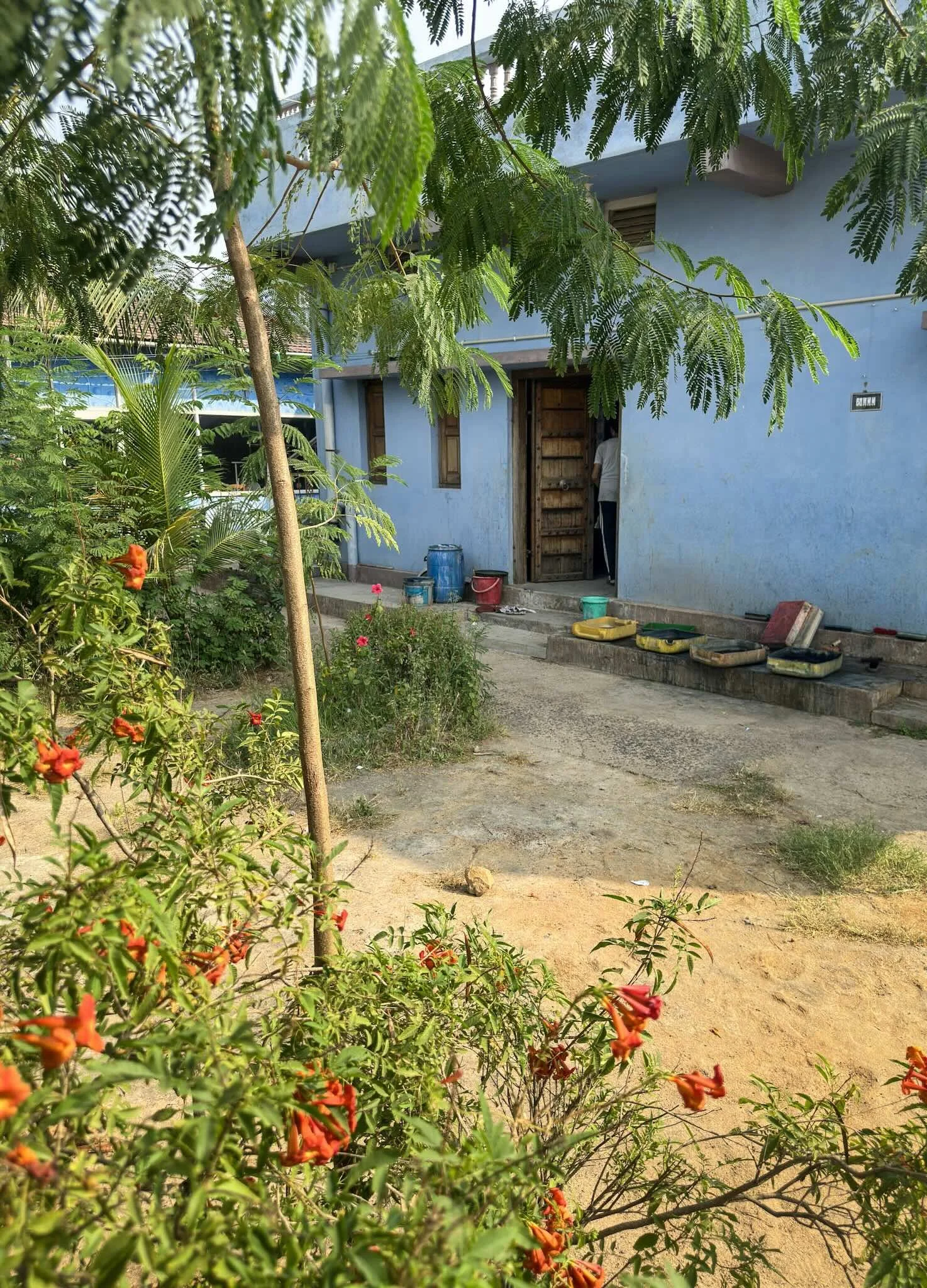
Outside the workshop in Ajrakhpur, the blue walls catching the light, flowers and greenery softening the dry ground.
Inside, the space was light-filled and generous. Shelves lined with wooden blocks in careful rows, and on the worktable a tray of small labelled jars: natural indigo, iron, myrobalan, madder, rhubarb root, alum, henna, lac. The palette of the craft.
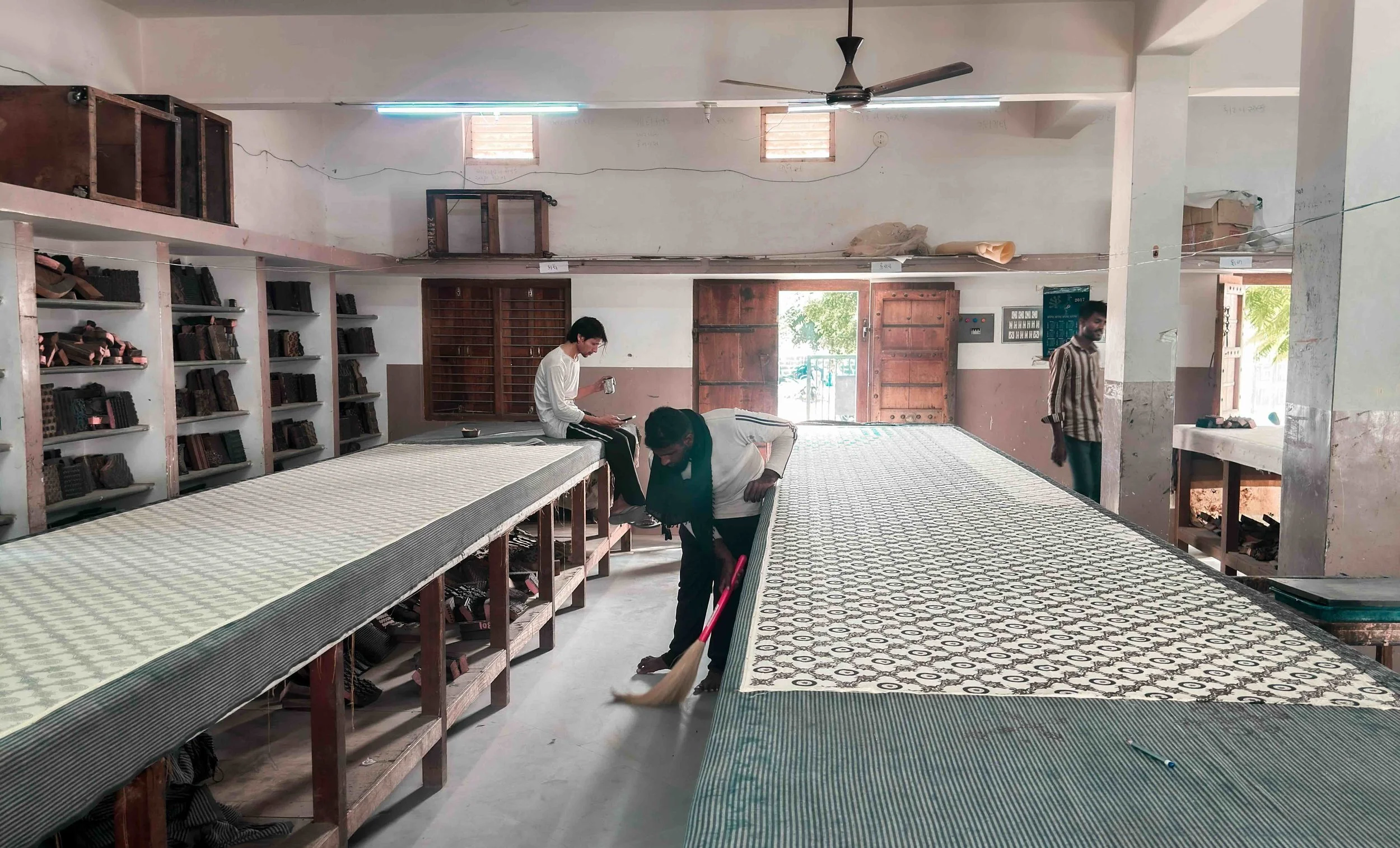
A corner of the workshop, cool, orderly, and briefly at rest.
There was something about the atmosphere of the place that I have been trying to find the right word for ever since. Purposeful. Calm. It felt less like a workshop and more like somewhere that had been doing this, in this way, for a very long time.
Faizan is an eleventh-generation Ajrakh printer. He told me this himself, with no fanfare, as though it were simply a fact. And, I later realised, he was only in his twenties.
Kuldip showed me a photograph on his phone: a six-year-old Faizan standing with him in the workshop. The two of them have known each other his entire life.
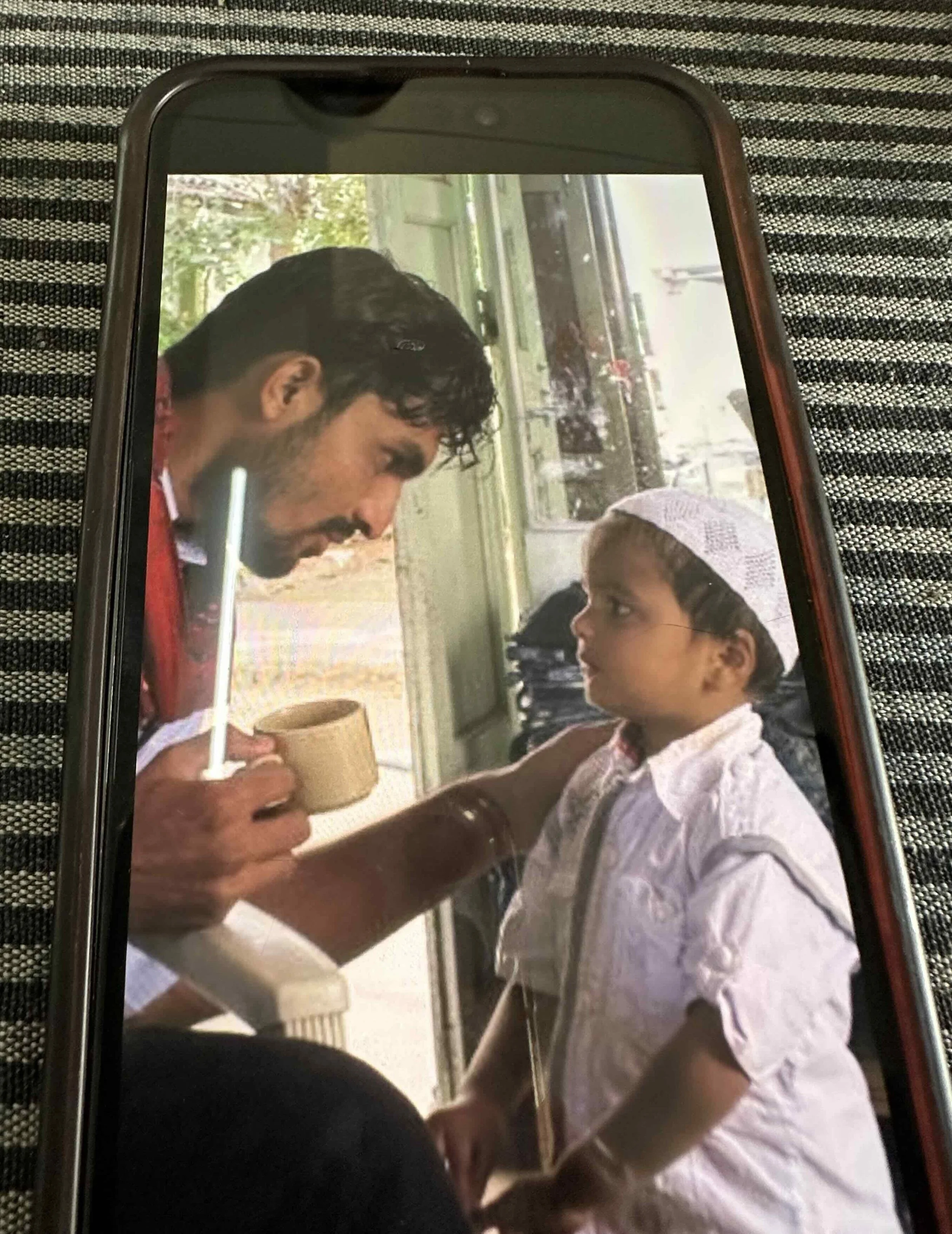
Faizan as a young boy with Kuldip at the workshop - a photograph Kuldip showed me on his phone.
Faizan credits his grandfather as the man who shaped everything he knows. Dr Ismail Mohammad Khatri is one of the most significant figures in the history of ajrakh. Not only a master printer but a central figure in the community’s relocation after the 2001 earthquake, when their village of Dhamadka was destroyed and Ajrakhpur was established.
He was awarded an honorary doctorate in Art by De Montfort University in Leicester in recognition of his contribution to the craft.
That history goes back much further. Faizan’s ancestors came from Sindh, settling eventually in Dhamadka, and the ajrakh tradition travelled with them intact - first to Dhamadka, then, after the earthquake, to Ajrakhpur.
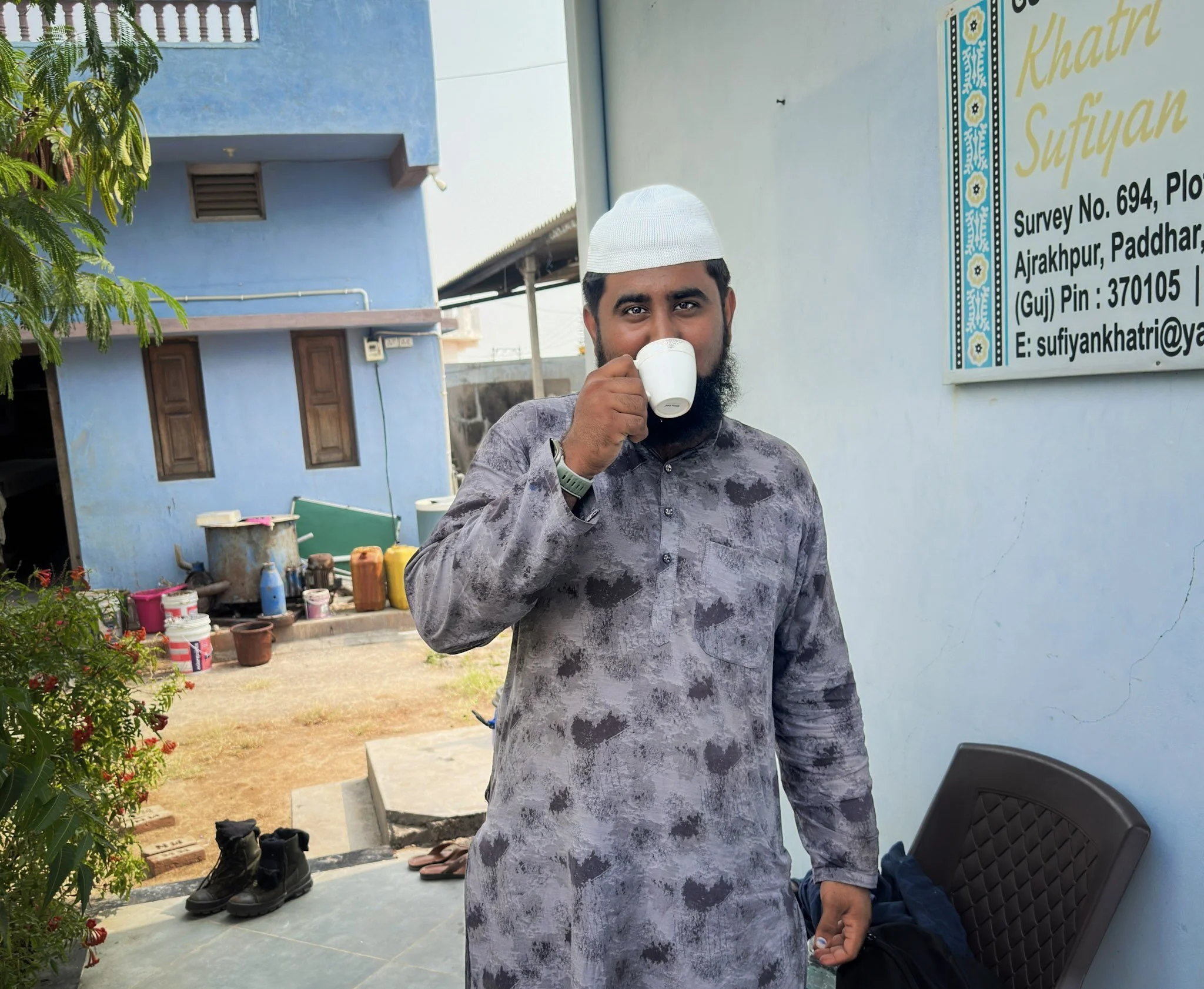
Faizan Khatri outside his father’s workshop in Ajrakhpur - the blue building, the orange flowers, the many cups of tea.
In His Own Words: The Process
What follows is, as closely as I can render it, what Faizan explained to me as we moved around his workshop - him demonstrating, and me trying to keep up.
The process, he told me, has sixteen steps.
What makes Ajrakh remarkable is that the cloth is printed on both sides, front and back, with the hand-carved blocks aligned with an accuracy that, watching it done, seems almost impossible. This double-sided printing is, Faizan said, one of the tradition’s defining marks.
Saaj (Scouring)
It begins not with printing but with rigorous preparation. Cotton cloth is soaked overnight in a mixture of camel dung, castor oil and soda ash to remove the weaver's starch.
Kasanu (First myrobalan treatment)
Cloth treated with myrobalan, a tannin-rich fruit. The tannin bonds to the fibre and prepares it to accept mordants and dyes permanently.The cleaned cloth is soaked in Harde (powdered myrobalan nut solution). This acts as the first crucial mordant to help natural dyes bind permanently to the fibre, leaving a yellow tint.
Wash, dry, wash.
Washed in running water, dried in the sun , washed again.
Sun drying.
Cloth stretched flat and dried completely on both sides in direct sunlight, activating the tannin compounds.
Rekh (Outline resist printing)
Printing begins. The rekh block lays down the fine outline using a resist paste of lime and gum arabic. Protects these outline areas from taking any future dye so they will remain crisp white.
. Kat (Black mordant printing)
Areas designated to become black are printed with Kat: scrap iron fermented with jaggery and tamarind seed powder into a thick dark paste. The iron reacts with the myrobalan tannin already in the fabric to produce permanent deep black.
Alum mordant printing.
A paste of alum (aluminum sulfate) and gum stamped onto areas designated to become red. Shows no colour at this stage but prepares those areas to react with madder root later.
Gach (Mud resist application) A thick resist paste
Gach - made from black clay and gum, applied over the printed cloth. Protects the mordant-printed areas during the indigo vat immersion.
Sawdust dusting
Fine sawdust or crushed cow dung powder dusted across the wet Gach surface. Locks the mud resist in place, prevents the clay layer from smudging as the cloth is handled.
Reverse-side printing
The cloth is printed on the reverse, blocks aligned to mirror the front with exact precision. Double-sided printing is one of ajrakh’s defining marks.
Drying
The fully printed cloth left to dry three to four days.
First indigo vat
Cloth submerged in a deep, underground natural indigo fermentation vat. Emerges green, oxidises to blue on contact with air.
Second indigo vat
Dried, then dipped again to deepen the blue to a rich midnight tone.
Washing
Taken to running water, washed thoroughly. Removes all the Gach, mud, clay and starch resists, exposing the undyed alum-treated areas beneath.The fabric is washed once more and treated with a light, diluted liquid alum or turmeric wash to lock in the absolute brilliance of the red and blue contrasts.
Bhatti (Madder boil)
Placed in a copper furnace (Bhatti) with water and madder root — known locally as manjistha, or alizarin. Brought to the boil. The alum-mordanted areas bloom into bright earthy red. The indigo remains unchanged.
The completed Ajrakh cloth receives its final wash in plain water to remove any lingering loose particles and is dried one last time in the open desert sun.
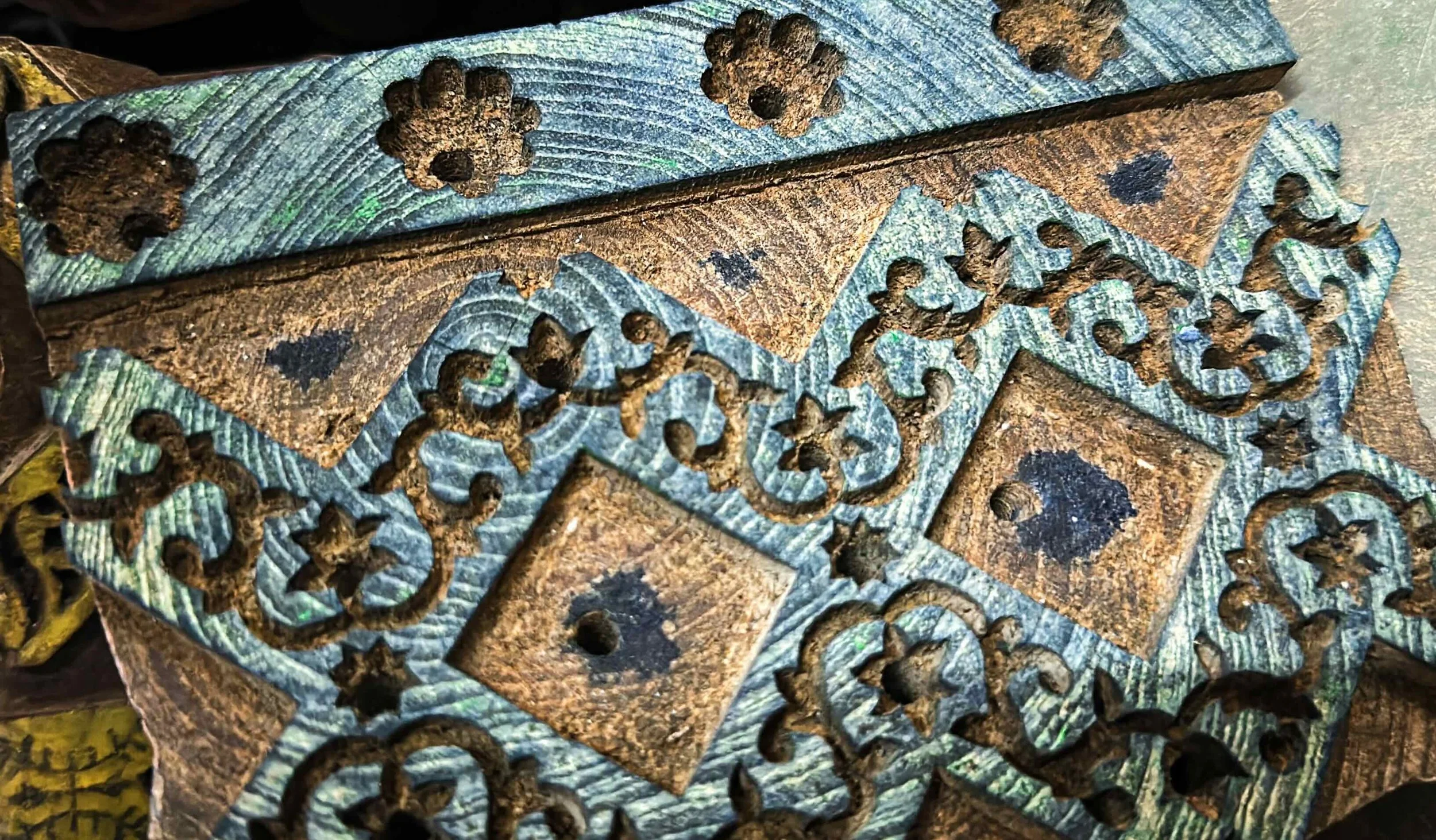
A printing block from Khatri Sufiyan Ismail’s workshop - the carving worn smooth with use, saturated deep with accumulated indigo.
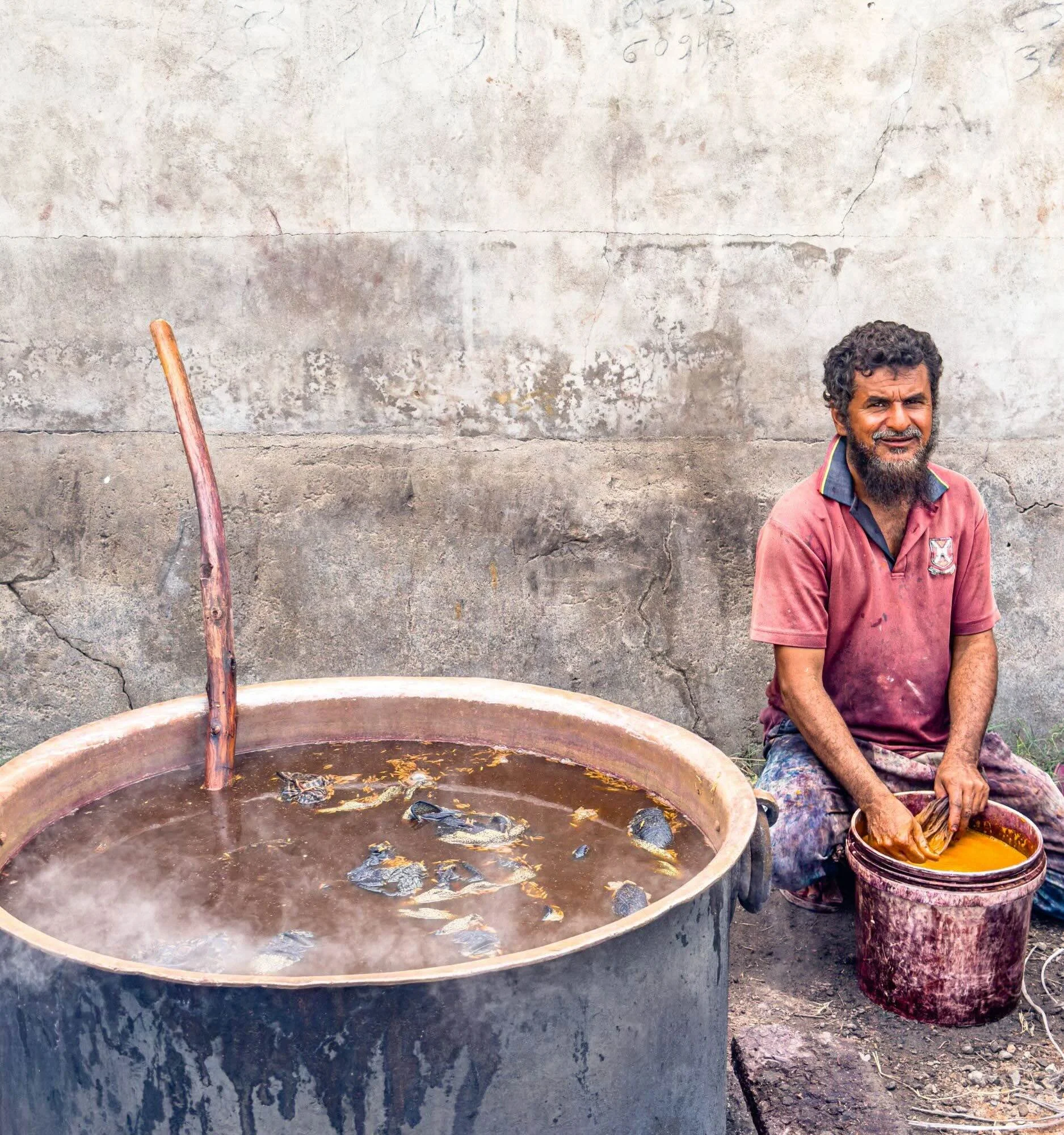
At the dyeing vats, Ajrakhpur -each stage of the process carried out outside, in the open air.
And the other dye samples in those labelled jars? Indigo, Rhubarb root, yielding extraordinary yellow tones and in combination greens. Henna leaves. Lac, a resin produced by an insect that nests on certain trees, the colour coming from the nest itself. Pomegranate skin combined with turmeric. Each one explained, each one demonstrated on a small swatch of cloth.
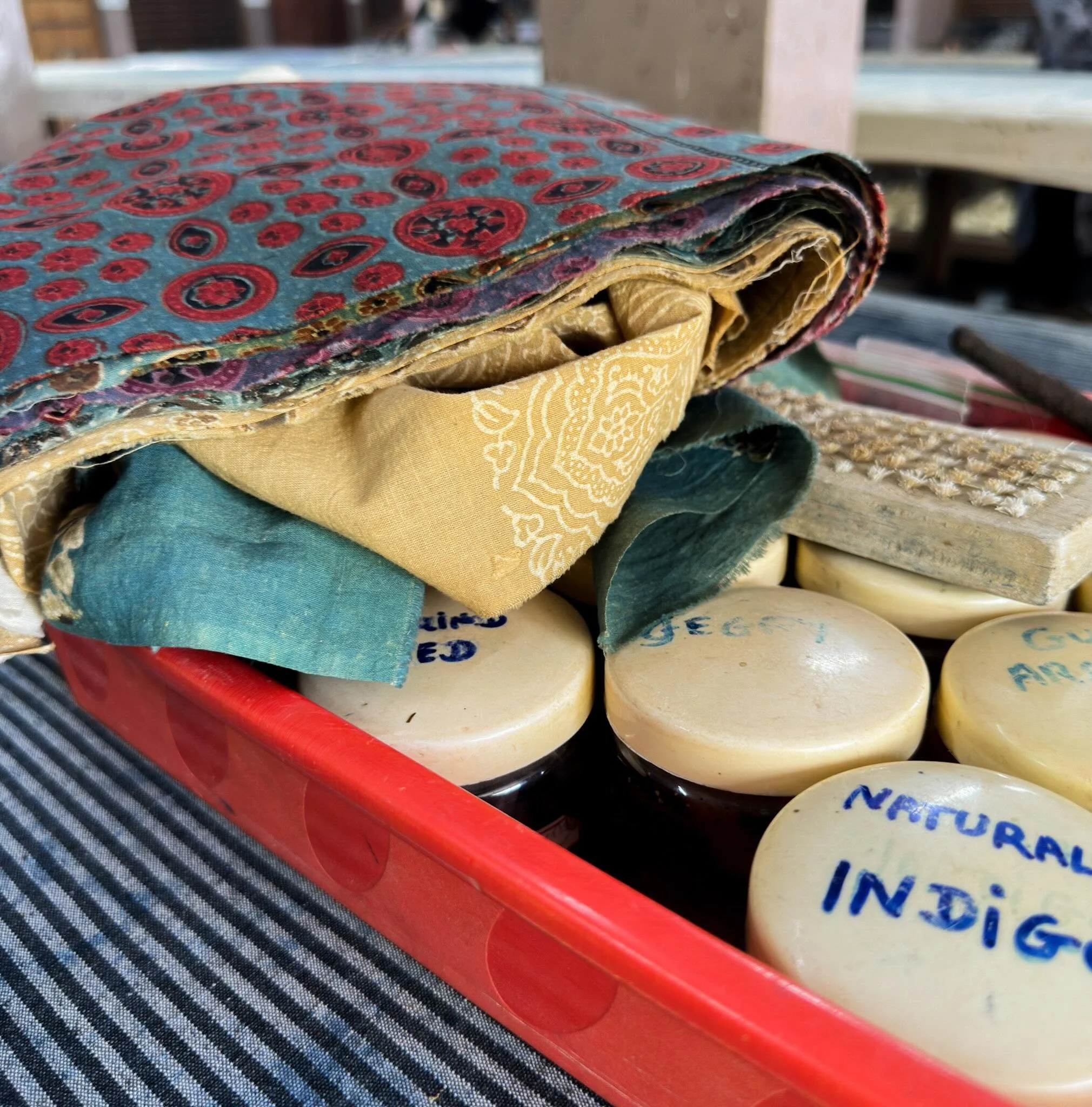
The palette laid out - labelled jars of natural dyes alongside fabric samples at Sufiyan’s workshop: indigo, madder, myrobalan, jaggery. Each one demonstrated on cloth.
Alizarin also plays a role, a dye Faizan described as,“ synthetic but eco-friendly”, used alongside natural dyes to achieve consistency in the reds.
The most complex form of the work, the most intricate, the oldest, is called meenakari ajrakh. Once the full sequence is complete, the entire process begins again: more resist printing, more iron, more alum, a further indigo dip, another boiling in madder. Layer upon layer, building the depth and complexity that distinguishes the finest pieces.
Faizan moved through all of this with the ease of someone explaining something they have known since childhood.
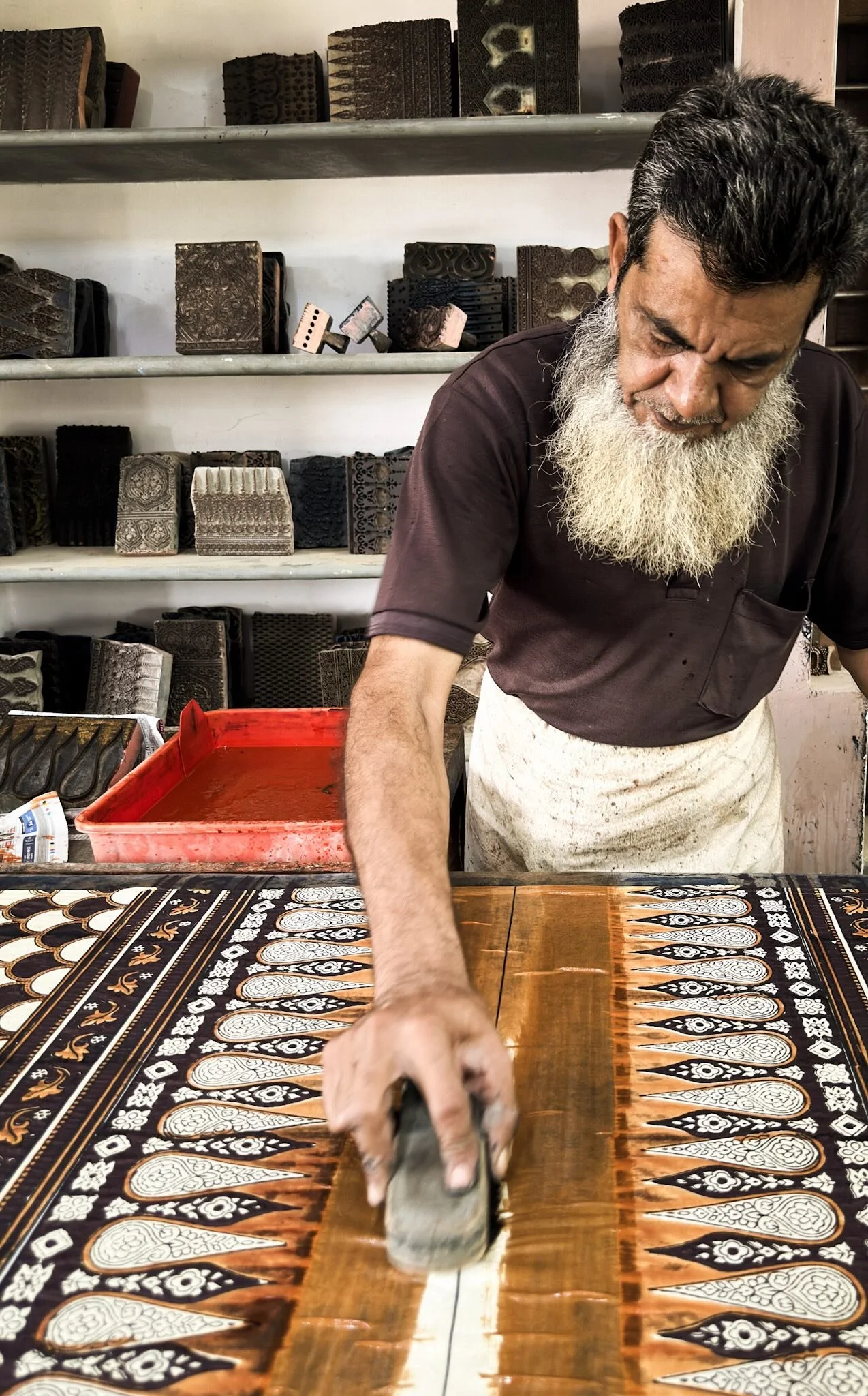
Rafiq Bhai Khatri at the printing table - shelves of blocks accumulated over generations behind him, each pass of the block building the pattern layer by layer.
The Cloth Itself
I have spent thirty years working with colour, sourcing it, specifying it, understanding how it behaves on different fibres in different lights. I thought I had a reasonable grasp of what natural dyes could do. Seeing Sufiyan’s finished cloth made me feel I had understood very little.
These are not the colours you expect. They are not rustic, not faded, not the slightly worthy palette that the phrase “natural dye” can sometimes suggest. They are extraordinarily rich and, at the same time, extraordinarily subtle. Colours that seem to exist in several tones simultaneously, that shift as the light moves across them. An indigo that is almost architectural. A madder red that glows.
I took photographs. They don’t do it justice.
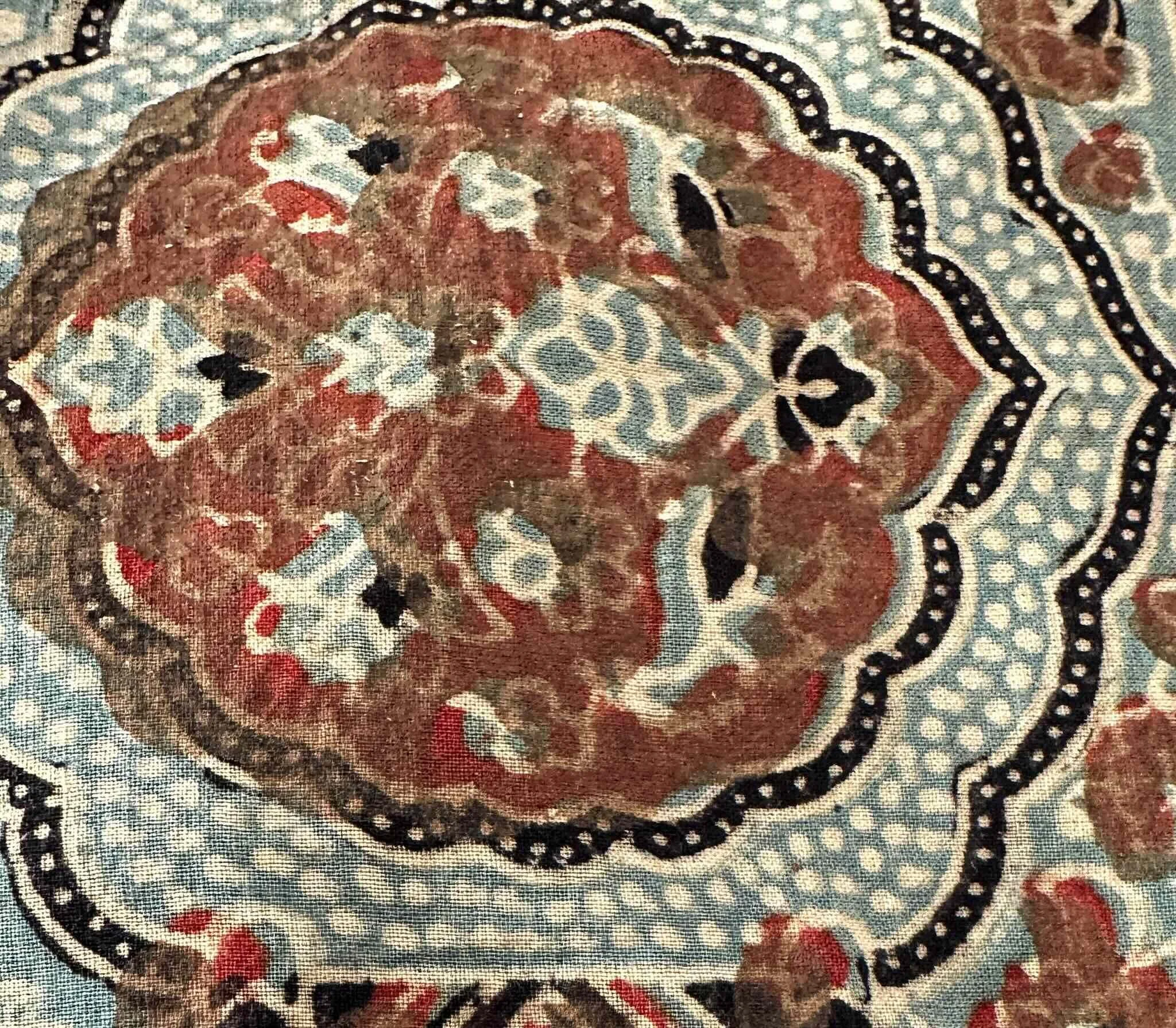
Ajrakh cloth mid-process at Khatri Sufiyan Ismail’s workshop — colour and pattern building layer by layer, not yet complete
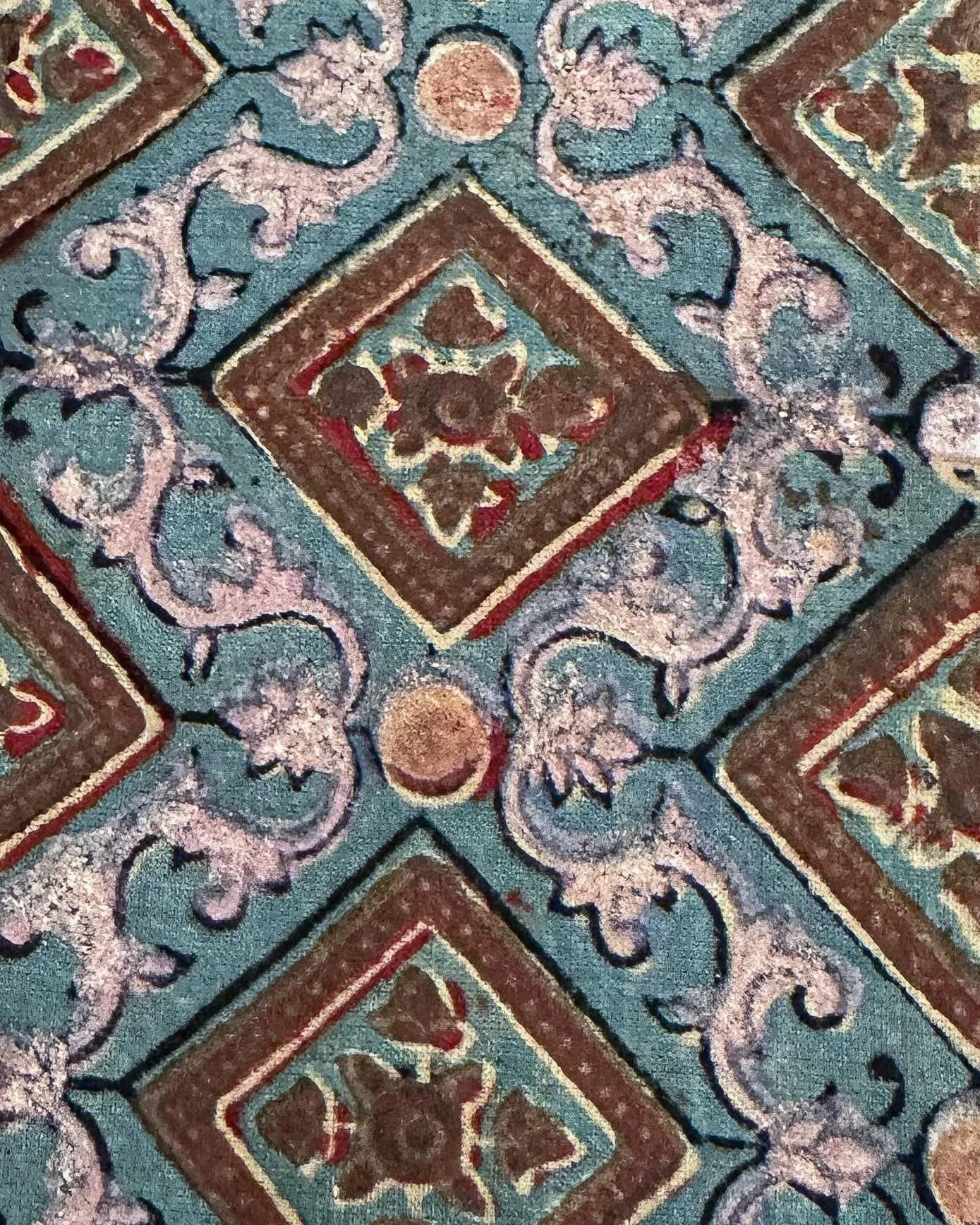
Another piece in progress, the geometric structure emerging through repeated printing and dyeing, the final depth still to come.
What Stays
I am already planning to return to Kutch and to spend much more time in Ajrakhpur. With Faizan, Kuldip and with the other workshops I visited, each of which deserves its own attention. There are questions I didn’t think to ask, things I didn’t fully understand in the moment. That is, I think, as it should be. This is a craft that rewards repeated attention and time.
When we come here on tour, we will give it both. At least two days, time in Faizan’s father’s workshop watching the printing, time in the dyeing units where the indigo vats and madder baths do their slow, patient work, and then back again, because once is never enough. I want the women who travel with me to stand in front of that finished cloth and feel what I felt: that particular disbelief that something this beautiful came from wood, water, plant roots and time. No machine. No shortcut. Just knowledge, accumulated across eleven generations, applied by hand.
For those who want to go further still, we can arrange a hands-on worskhop to demonstrate the process. Your block in hand, natural dyes, the sequence from the beginning. There is no better way to understand what you are looking at.
It is, in the most literal sense, alchemy.
And I cannot wait to share it.
Bernadette O’Farrell has spent thirty years working with artisan communities primarily in Rajasthan and Kerala. She leads small-group cultural and textile journeys for women through India with Bernadette.