

By Bernadette O’Farrell
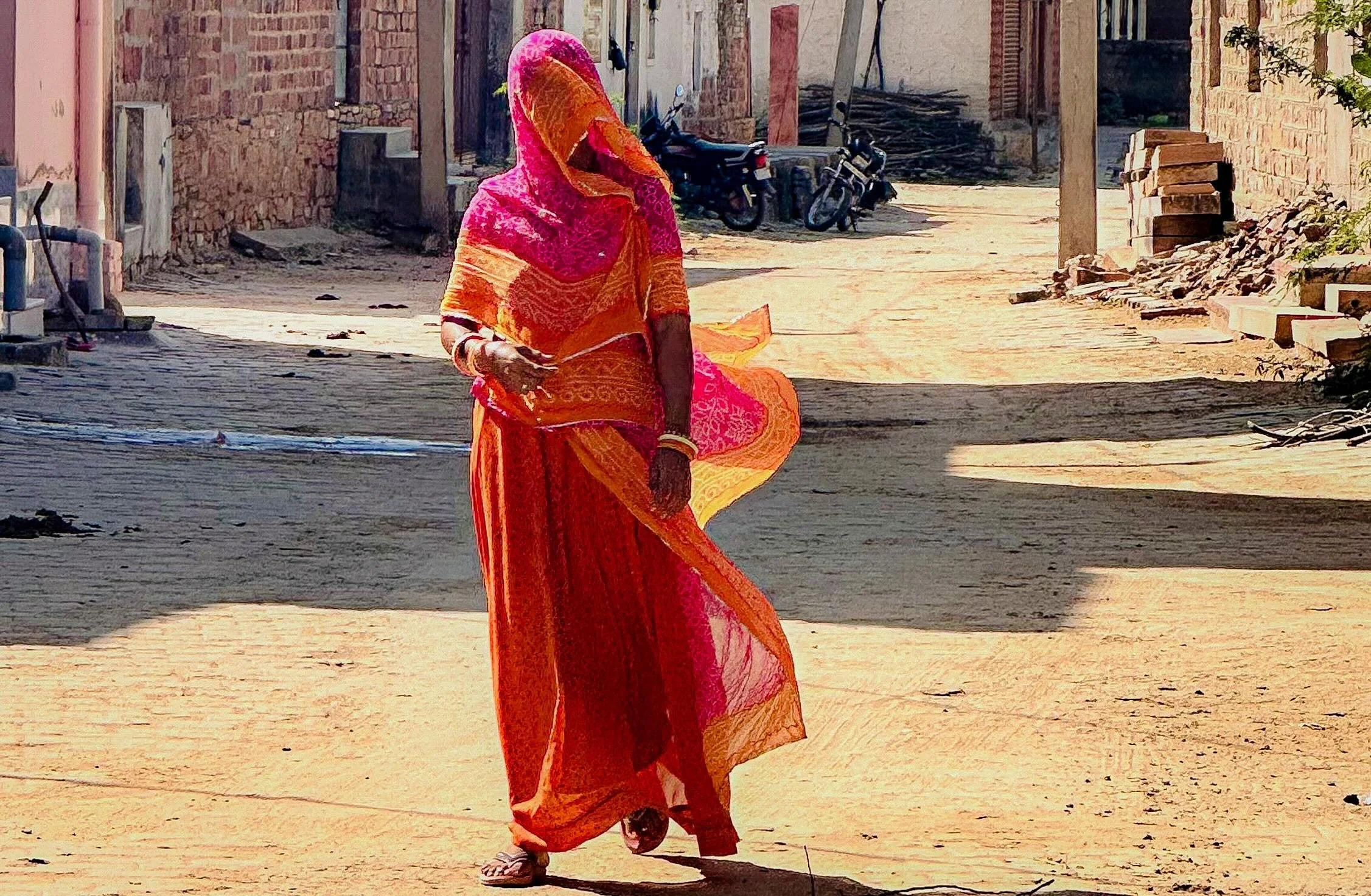
A woman crosses a village street in Rajasthan, her pallu drawn forward, the cloth moving with her
There is a moment you notice in Rajasthan, once you have been there long enough to stop looking at everything and start seeing it. A woman crossing a courtyard, a load balanced on her head, the pallu of her odhni drawn forward over her face. How she sees through it I have never entirely worked out. She moves with a sureness and a grace that has nothing to do with effort. The cloth moves with her. It is not separate from her. It is simply part of how she is in the world.
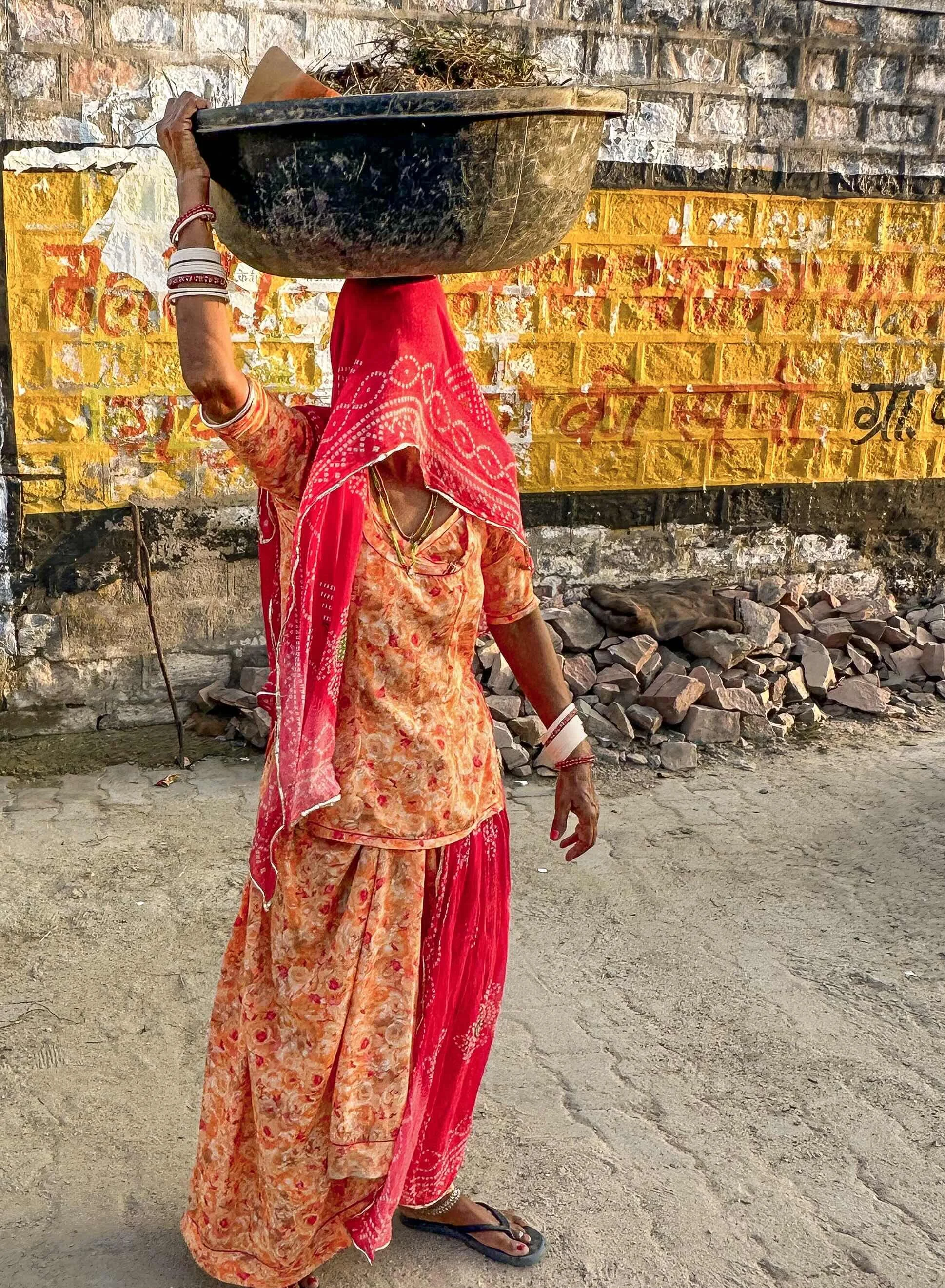
A woman carries a load through a Rajasthani village, her pallu drawn forward, bangles to the elbow, her odhni in bandhani cotton.
The pallu is the free end of the odhni, the long veil worn by women across Rajasthan, usually with a ghagra (skirt) and choli (blouse). It is tucked, draped, pulled across the shoulder and over the head. In its simplest form it is practical: shade from the desert sun, modesty in a conservative rural society, a cloth that can carry, cover, wipe, wrap. But reduce it to its function and you miss everything that matters about it.
The reasons women wear the odhni, and draw the pallu forward, are multiple and not always easily separated. At its most practical, it protects against the desert sun, dust, and heat. Socially, it is tied to ideas of modesty and respect. In many communities, particularly for married women, covering the head or face in the presence of older male relatives is a way of acknowledging hierarchy and family structure.
There is also, at times, a more pragmatic layer. In rural settings, where young women can still attract unwanted attention, the veil can act as a form of protection. It signals modesty, but also inaccessibility. Not invisibility, but a boundry.
There is also an element of identity, of belonging to a place, a community, a way of life. Alongside all of this, there is choice and personal expression.
The Pallu is not one thing, but many, held together in a single gesture.
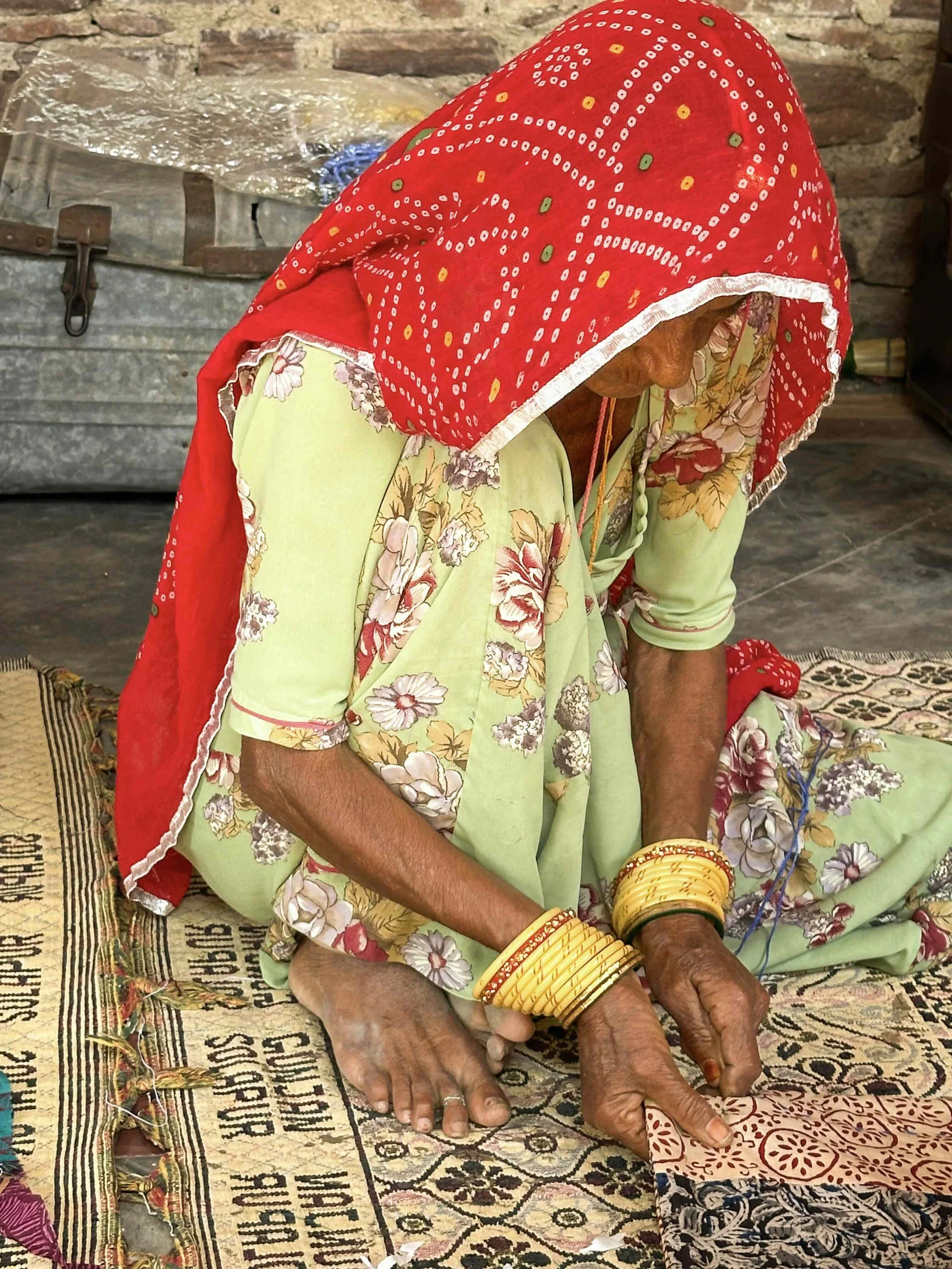
A woman at work in Chandelao, her pallu falling forward as she bends, the cloth doing what it always does.
Traditionally, the odhni is made from fine cottons or cotton-silk blends, light enough to breathe in the heat, sometimes gauze-like, sometimes more structured. It may be dyed in bandhani, the intricate tie-dye particular to Rajasthan and Gujarat, or in leheriya stripes, or resist-printed by hand: in dabu, using a mud paste that protects the cloth from dye, or block-printed with carved wooden stamps. Borders are often finished with gota patti, a metallic appliqué that catches the light. These are not incidental details. They are part of a long textile language, understood locally and worn daily.
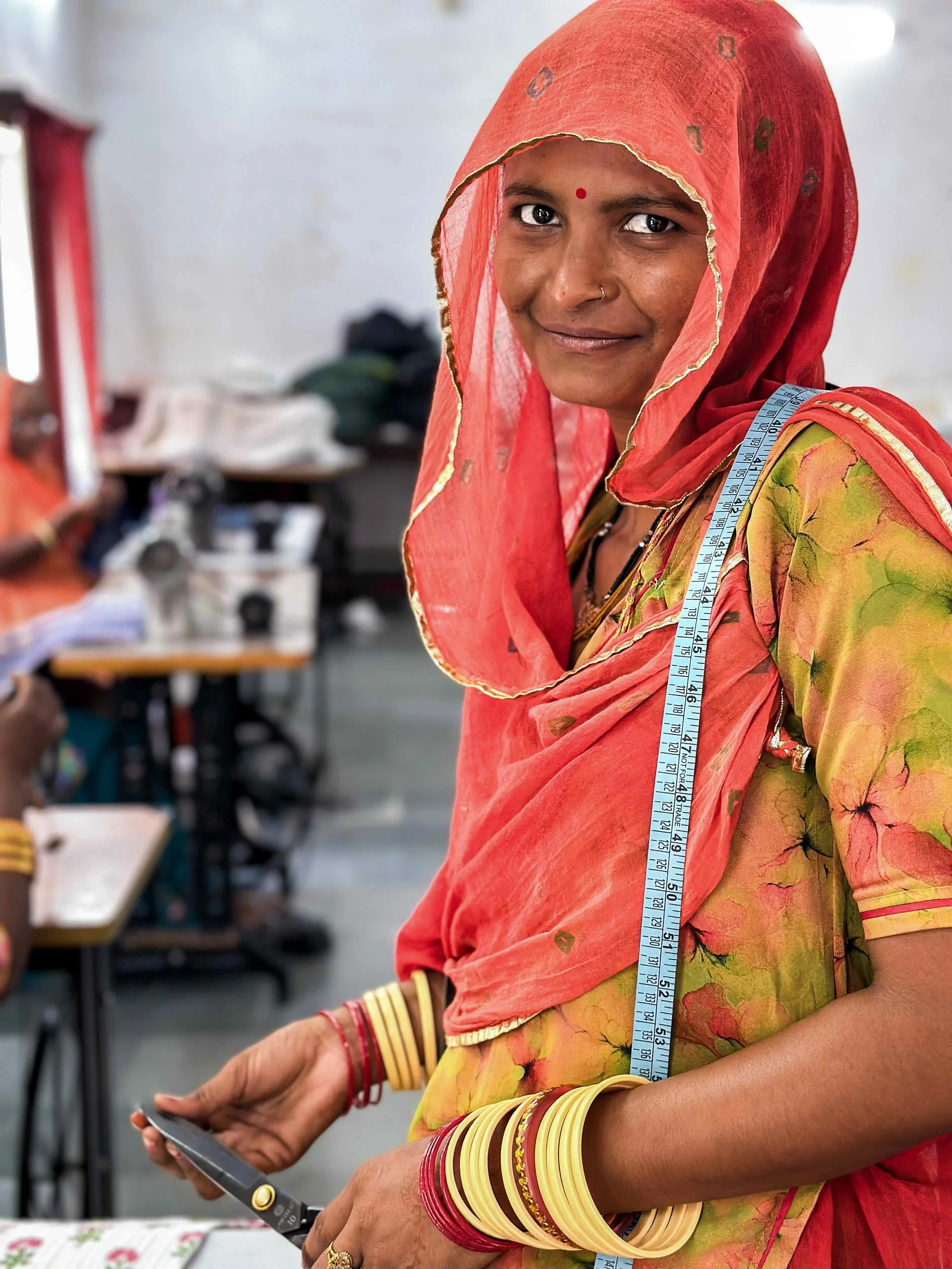
A seamstress at Sunder Rang, Chandelao, in a mulmul cotton odhni.
What strikes me every time, after thirty years of travelling through Rajasthan, is the femininity of it. From the youngest girl to the oldest woman, the pallu alters the way a woman moves. It gives every gesture an extension, a softness, a frame. A woman pushing open a door, turning to speak, bending to her work: the cloth follows a half-second behind, settling. It flatters every age and every figure. I have never seen it look wrong on anyone.
And the colours. Vivid, unrestrained and unmissable.
Rajasthani women in the villages wear colours that seem almost to generate their own light, fuchsia, saffron, peacock blue, vermilion, acid yellow, often several at once, against skin that makes them sing even louder. Bangles stacked to the elbow. A nose ring. A maang tikka catching the light.
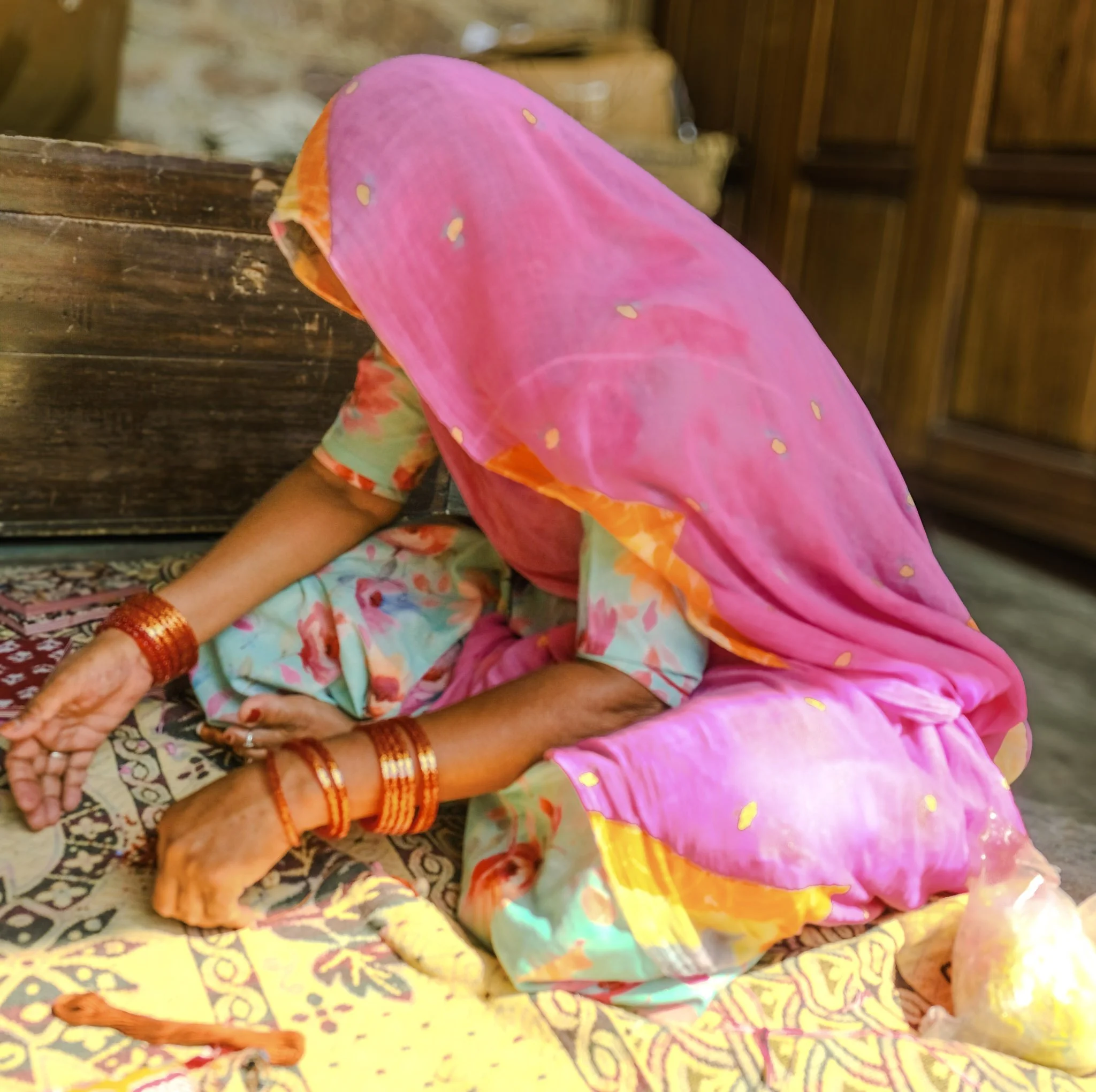
A woman at work in Chandelao, her pallu falling forward as she bends, the cloth doing what it always does.
Colours are not chosen at random. They carry meaning here. Red for marriage and fertility, yellow for ritual and auspicious days, green for life and renewal. Even combinations can signal region, community, or stage of life. What appears exuberant is often precise, understood without being spoken.
Here is what I have come to think, after years of watching. It begins in childhood. A love of colour and dress absorbed from the women around them, mothers, grandmothers and aunts. The pallu is not a constraint. It is an adornment. It is theirs.
I have sat in workshops in rural Rajasthan where women looked at my plain linen shirt and dark trousers with genuine puzzlement. Why so dull? Where are the colours? One woman in Barmer touched the fabric of my sleeve, looked up at me and laughed, not unkindly, but with the clear implication that I had rather missed the point of getting dressed.
These are the communities I have been returning to for thirty years, and the ones I now take small groups of women to meet.
The way the odhni is worn shifts subtly depending on context. It may be pulled fully forward over the face (known as ghoonghat), in the presence of older male relatives, as an expression of laaj, the complex sense of modesty and honour that shapes much of social life in rural Rajasthan. More often, in daily life, it rests loosely over the head, or is drawn across the face only briefly.
When working, it is tucked firmly into the waistband or blouse to free the hands. In some communities, the drape is more structured. In others, looser, adapted to movement and labour. There is no single way of wearing it, only a shared understanding of when and how.
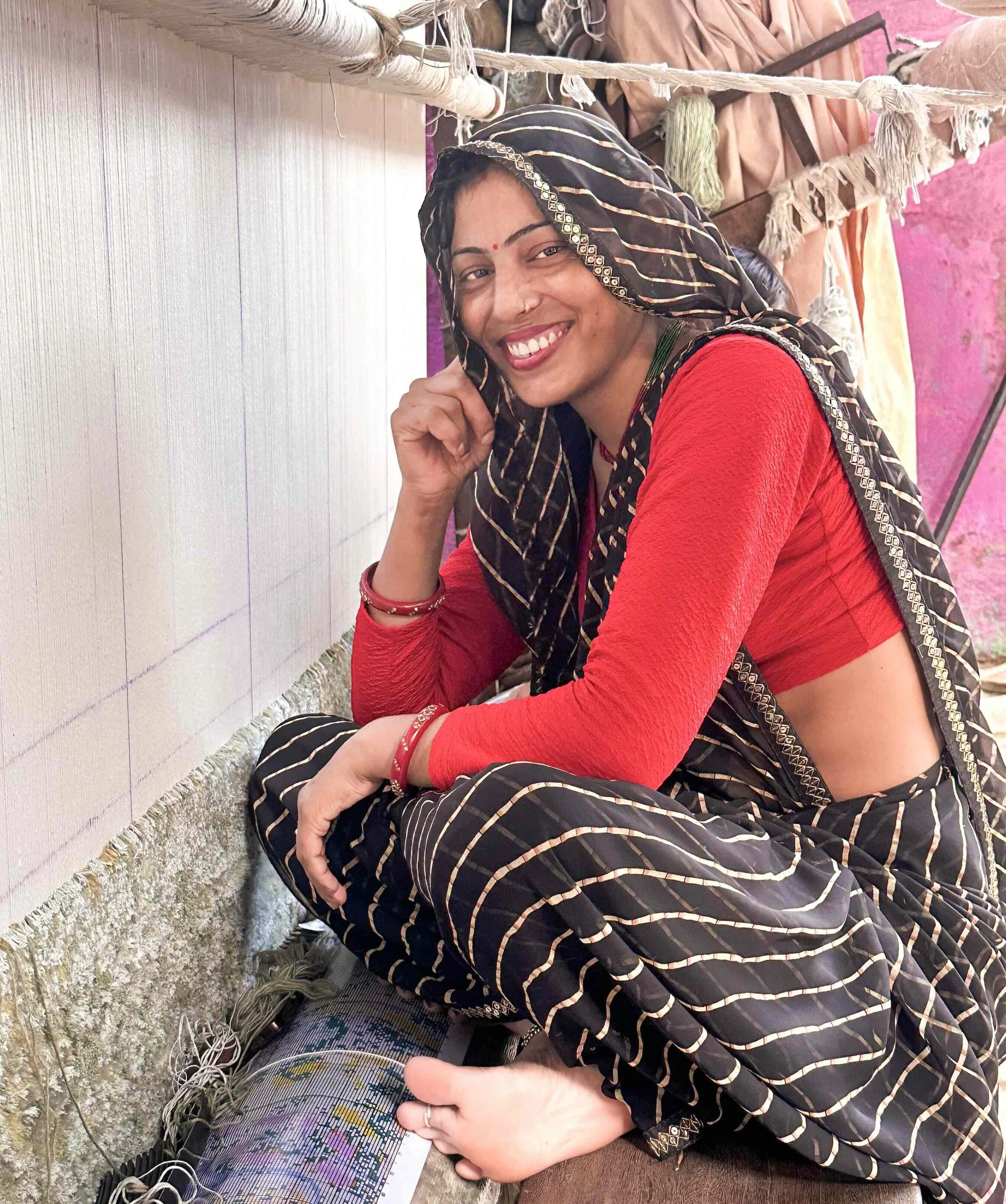
A weaver at her loom in a village outside Jaipur, making rugs for Jaipur Rugs. Her odhni is leheriya, the diagonal stripe cloth of Rajasthan.
The practice itself has a long and complex history. Veiling in India can be traced to the idea of avagunthana, a form of veiling or face covering described in early classical texts. Over time, particularly during the medieval period, stricter forms of veiling became more common in parts of North India, including Rajasthan, shaped by social hierarchy, ideas of honour, and changing political conditions. In many Rajput households, it became closely tied to status and etiquette.
Today, that history sits alongside a changing present. In cities, the practice has largely receded.
In villages, it remains part of everyday life, though often worn more lightly than before. There have been recent campaigns in Rajasthan encouraging women to move away from full face veiling, framing it as a question of mobility and autonomy. And yet, for many women, the odhni continues to hold meaning, not only as a social signal, but as something deeply familiar, practical, and personal.
One thing I have learned, and would pass on to anyone travelling in rural Rajasthan: always ask before you photograph a woman. Always. Not a gesture or a raised camera with a questioning look, but a genuine pause, eye contact, time.
What you will often see, if you wait, is a woman reaching up and draw her pallu forward, arranging it just so before she faces the lens. It takes perhaps ten seconds. What it produces is not a candid shot. It is something better. A woman who has chosen to be seen, on her own terms, in the way she wishes to present herself to the world.
Bernadette O’Farrell has spent thirty years working with artisan communities primarily in Rajasthan and Kerala. She leads small group cultural and textile journeys for women through India with Bernadette.