

By Bernadette O’Farrell
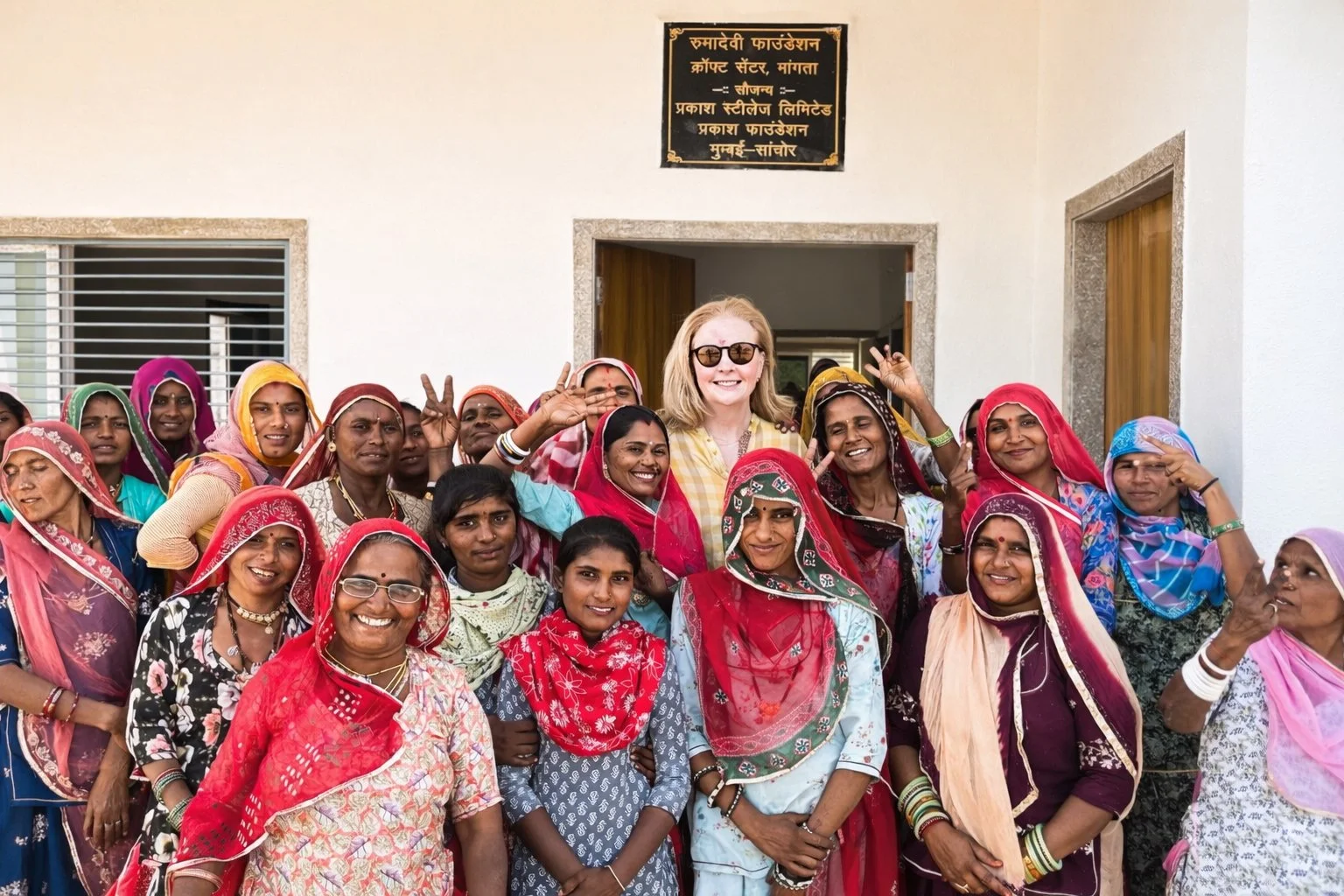
Ruma Devi Foundation Craft Centre, Bhangta, Barmer.
Ruma Devi is a woman from Barmer, in the remote western reaches of Rajasthan, who has spent twenty years building one of the most significant grassroots craft movements in India.
Starting with ten women, one hundred rupees each, and a second-hand sewing machine, she has trained and mobilised over fifty thousand rural artisan women across the Thar Desert. Most people outside India have never heard of her.
I hadn’t originally planned to stop in Barmer. I was travelling from Jodhpur to Kutch. A fifteen-hour drive I’d chosen over the train and a friend suggested the detour. There were artisans here, he said. Women making extraordinary things. I’d been wanting to see Barmer for years. So I stopped.
It was just after Diwali, and the celebrations were still going on, that particular, unhurried quality of festival aftermath that settles over small towns in Rajasthan. The hotel was new and quiet, with views over a landscape still showing faint bruising from a severe monsoon; floods had swept through weeks earlier, though the town had largely recovered.
My first stop was the showroom at the Gramin Vikas Evam Chetna Sansthan ( GVCS), on the outskirts of Barmer town. I walked through it slowly. The range was considerable: embroidery, mirror work, appliqué, woven textiles, garments. The quality was immediately evident. I was in the middle of examining a piece of cutwork when someone asked if I would like to see the village, and meet the women who made it. I said yes, and followed.
We wandered through the village for a while, the kind of wandering that always turns up something unexpected in India and eventually I was asked if I would like to meet Ruma Devi. I always say yes to that kind of question.
The Woman at Her Door
She met me at her home, still dressed for Diwali in a turquoise ghagra choli, pink dupatta and gold maang tikka. Before I had crossed the threshold I was surrounded with hugs, smiles and the kind of warmth and hospitality that you never forget. The house was warm and bright, the smell of chapati and spices cooking on an open fire coming from somewhere at the back. Children ran in and out.
Ruma Devi herself was quiet. That’s the word I kept returning to afterwards: a quality of stillness, an unhurried directness, and a smile that didn’t perform. What I noticed most was the way every other person in the room responded to her. She commanded love and respect, but softly, entirely without display.
We spoke through a translator. Her story came slowly, in the way stories told through a second language sometimes do, a little uneven at the edges, but perfectly clear at the centre.
She was born in 1988 in Barmer, in the remote western reaches of Rajasthan, where the Thar Desert begins to flatten and open out. She lost her mother in childhood. She left school after Class 8 and married at seventeen. Shortly after her marriage, she had a child and the baby died forty-eight hours after birth.
“That truly broke her heart,” the translator said. “She lost her will to live. But she is strong, and in that moment she realised that money and empowerment is important. Without money you can’t do anything.”
From grief, she made a decision. Not a grand one, simply a decision to act. She gathered ten women from her village. Each contributed one hundred rupees. Together, they bought a second-hand sewing machine and began making handbags.
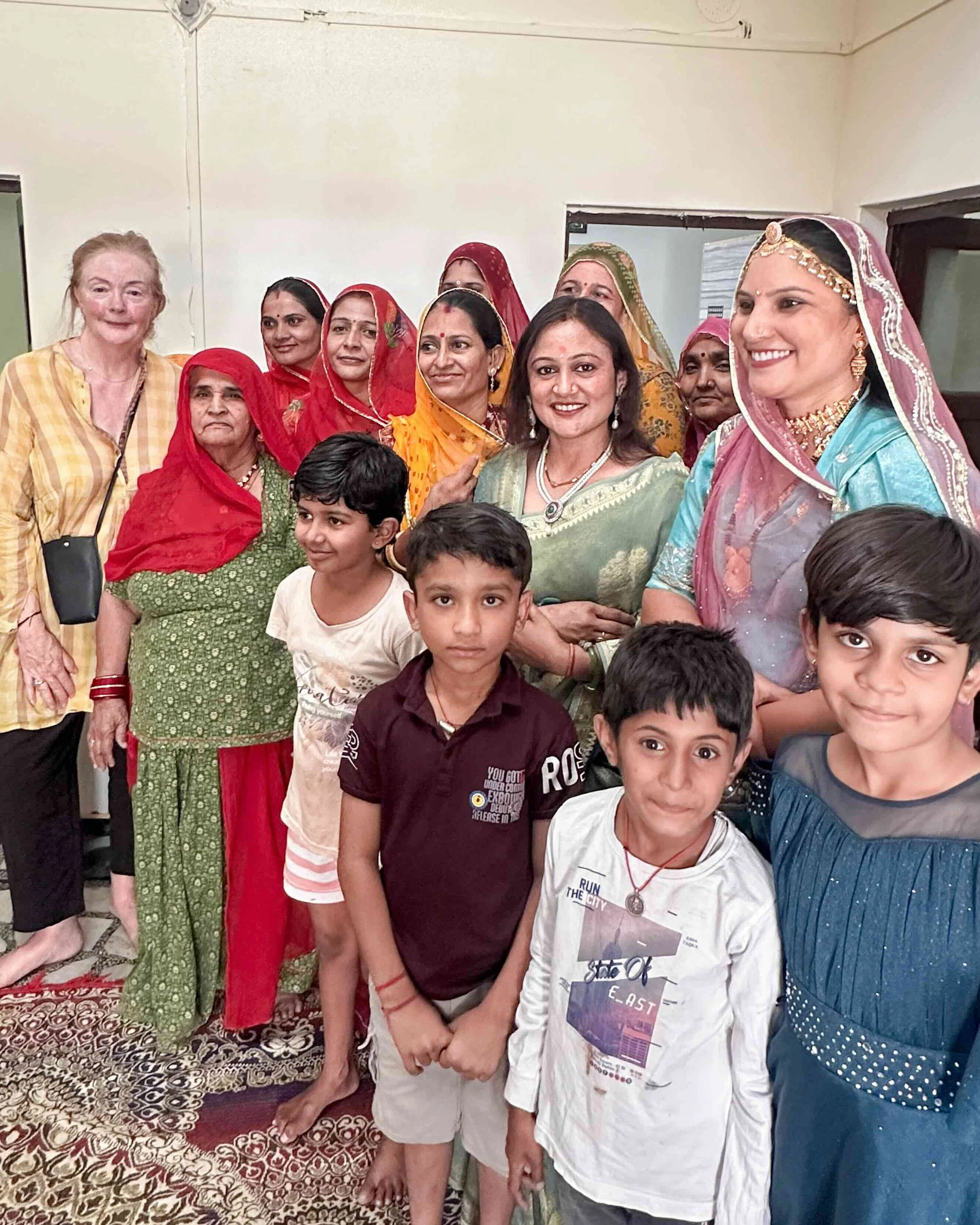
Ruma Devi with her family at home in Barmer during Diwali celebrations, 2025.
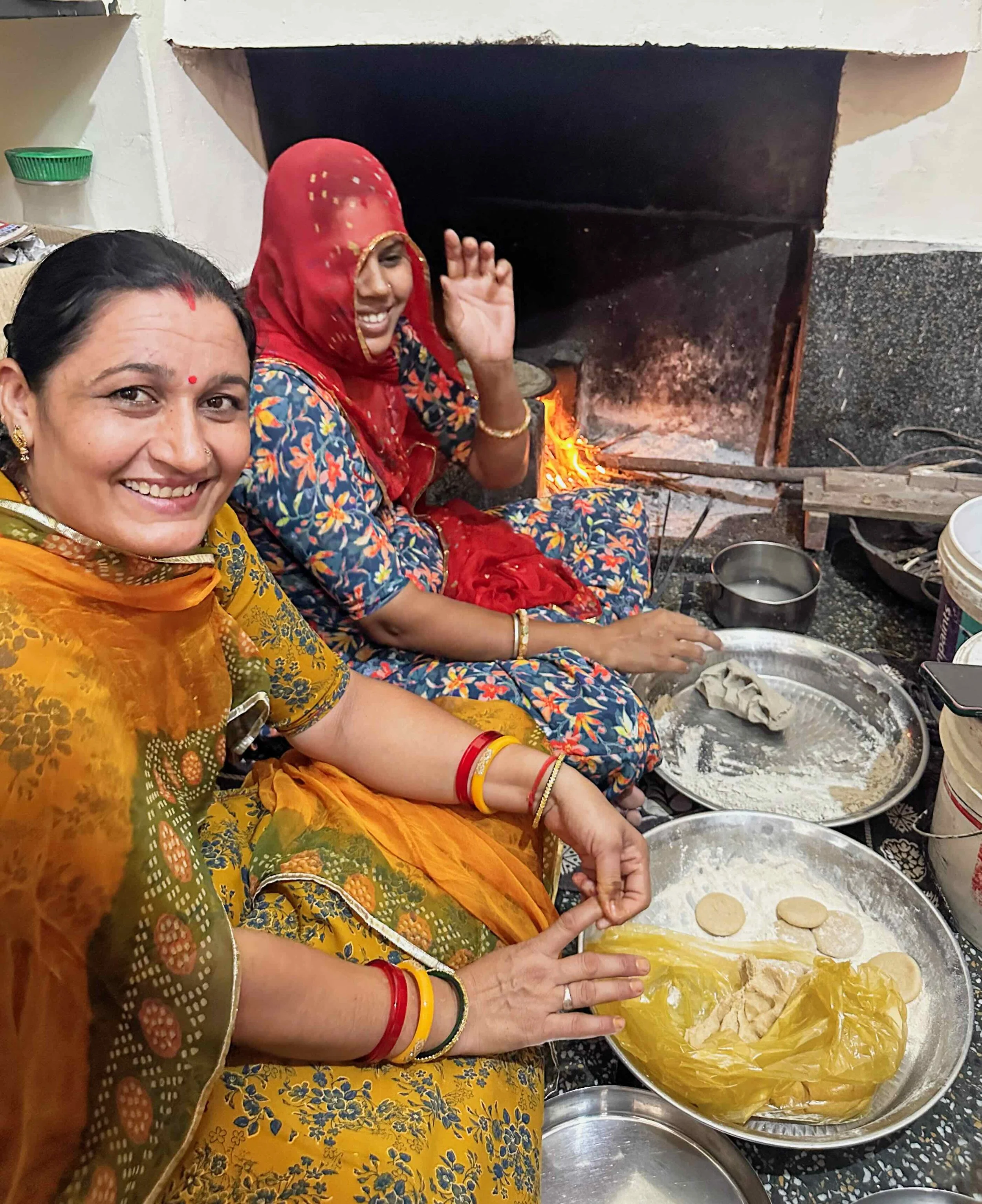
Two women cooking chapati on an open fire in Ruma Devi’s kitchen, Barmer, Rajasthan
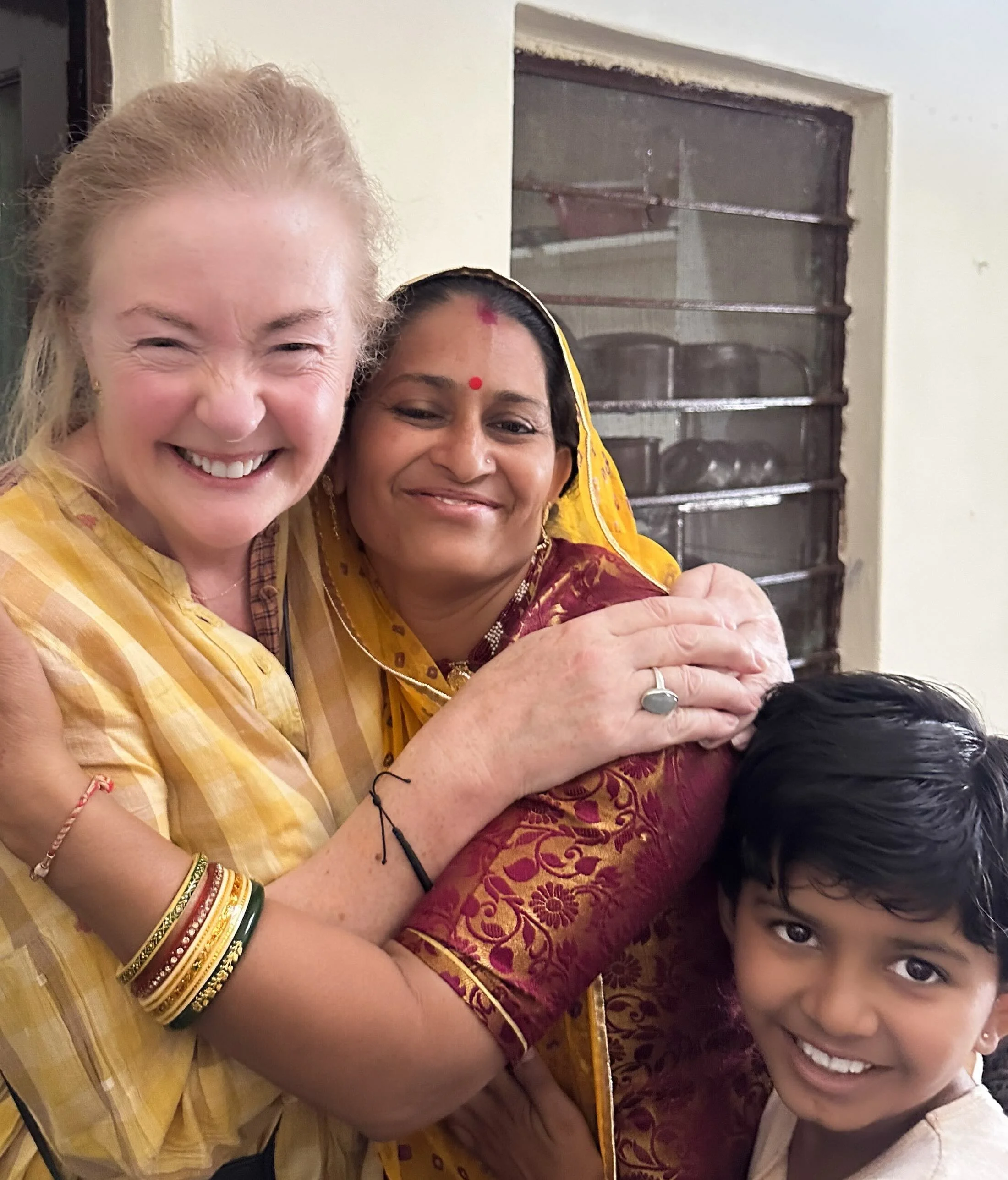
The welcome at Ruma Devi’s home, Barmer - Diwali 2025.
The Work
From her home, she arranged for me to be taken to the foundation’s craft centre in the village of Bhangta, about fifty kilometres from Barmer town. The building was new, purpose-built, funded, as the plaque above the entrance records, by Prakash Steelages Limited and the Prakash Foundation of Mumbai.
The women had been expecting me. Several came outside as I arrived, garland after garland was placed over my head, a welcome that took me entirely by surprise with its warmth.
Then I stepped inside, and the work stopped me. The women were seated cross-legged on the floor . A spotlessly clean floor, as these workrooms always are. They were doing katab, the traditional cutwork appliqué particular to Barmer and unlike anything produced elsewhere in India. I was given a chair. They had the chisels, the needles, the fabric folded across their laps. To understand why it stopped me, you need to understand what they were making.
Katab work (cutwork) is not embroidery in the usual sense. It begins with fabric, a beautiful Indian cotton onto which a design is first traced in precise, unhurried lines. Traditional motifs run to trees of life, leaves, animals, geometric forms; the vocabulary of the Thar Desert translated into pattern.
The fabric is then folded and layered, and the design is cut through the layers using a small hammer and chisel. Not scissors. A chisel. The cut pieces are fixed to a muslin (malmal) base cloth using lai, a traditional paste made from wheat flour, gum, and water and then finely stitched by hand with a fineness that makes the join almost invisible. The result, depending on the colours chosen, can be vivid and graphic, or in the white-on-white pieces I saw being made that day, something quieter and lovely: a semi-translucent surface where the pattern seems to float against its ground, the cut cotton fine and light, creating a window pane effect.
I have sourced white cutwork for thirty years. I’ve bought it for my own companies, sold it to international retailers, and carried pieces home for friends on every trip to India. It works in every climate and every interior. A white cutwork bedspread washes beautifully, needs no ironing, and looks as good in a London bedroom as it does in Rajasthan. The orange and red pieces they were working on that day were destined to become cushion covers and wall hangings.
The precision of the chisel work, the evenness of the stitching, and the quality of the underlying cotton were as good as anything I have seen. This cannot be made by machine. There is no shortcut in it anywhere.
Several of the women spoke English, self-educated, they were direct about what the centre represented to them: a way out of a specific set of domestic constraints that had previously made their skills invisible. They had met resistance. Some still did. But they had come together around the work.
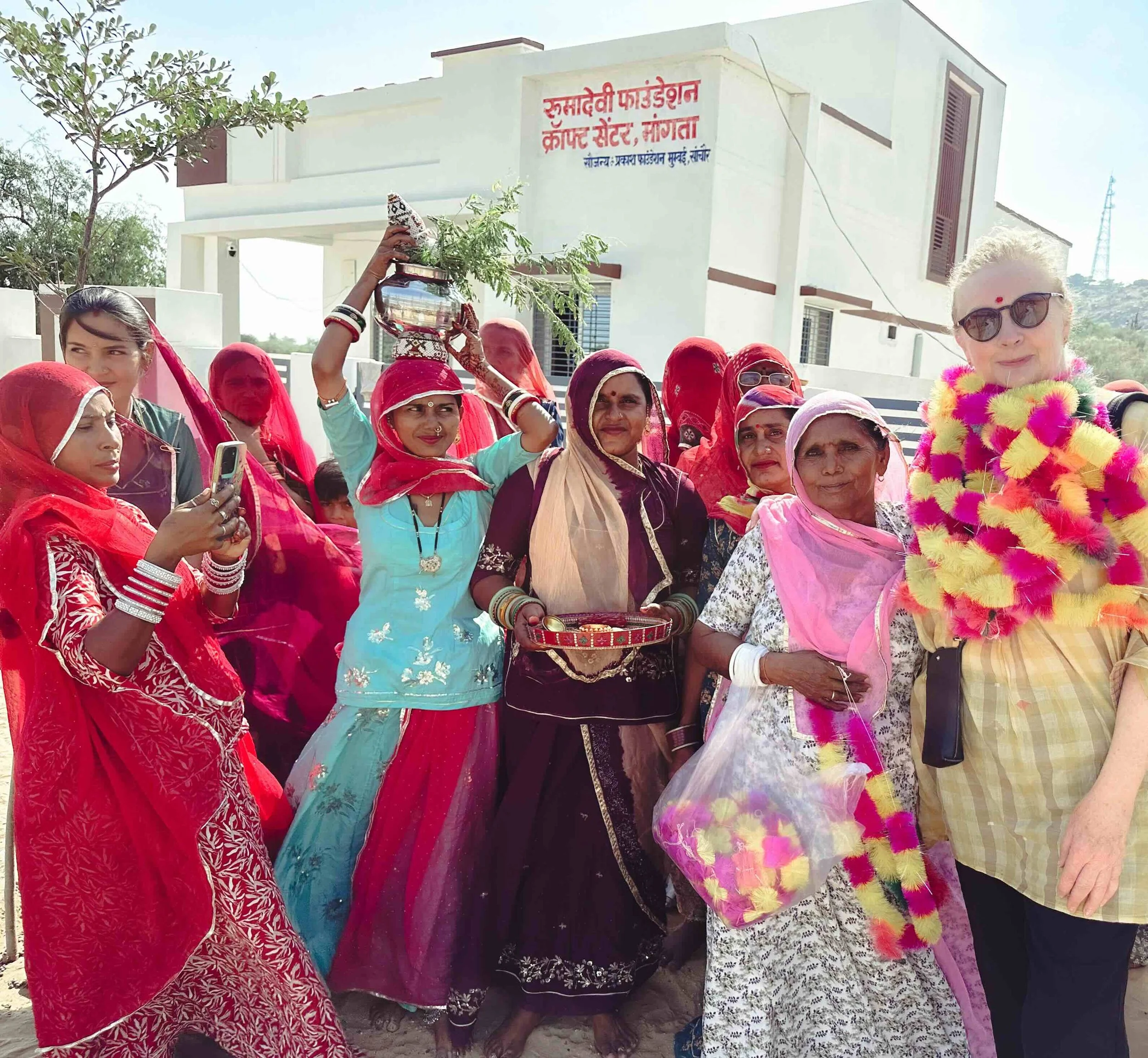
Arriving at the Ruma Devi Foundation Craft Centre, Bhangta, Barmer district, October 2025.
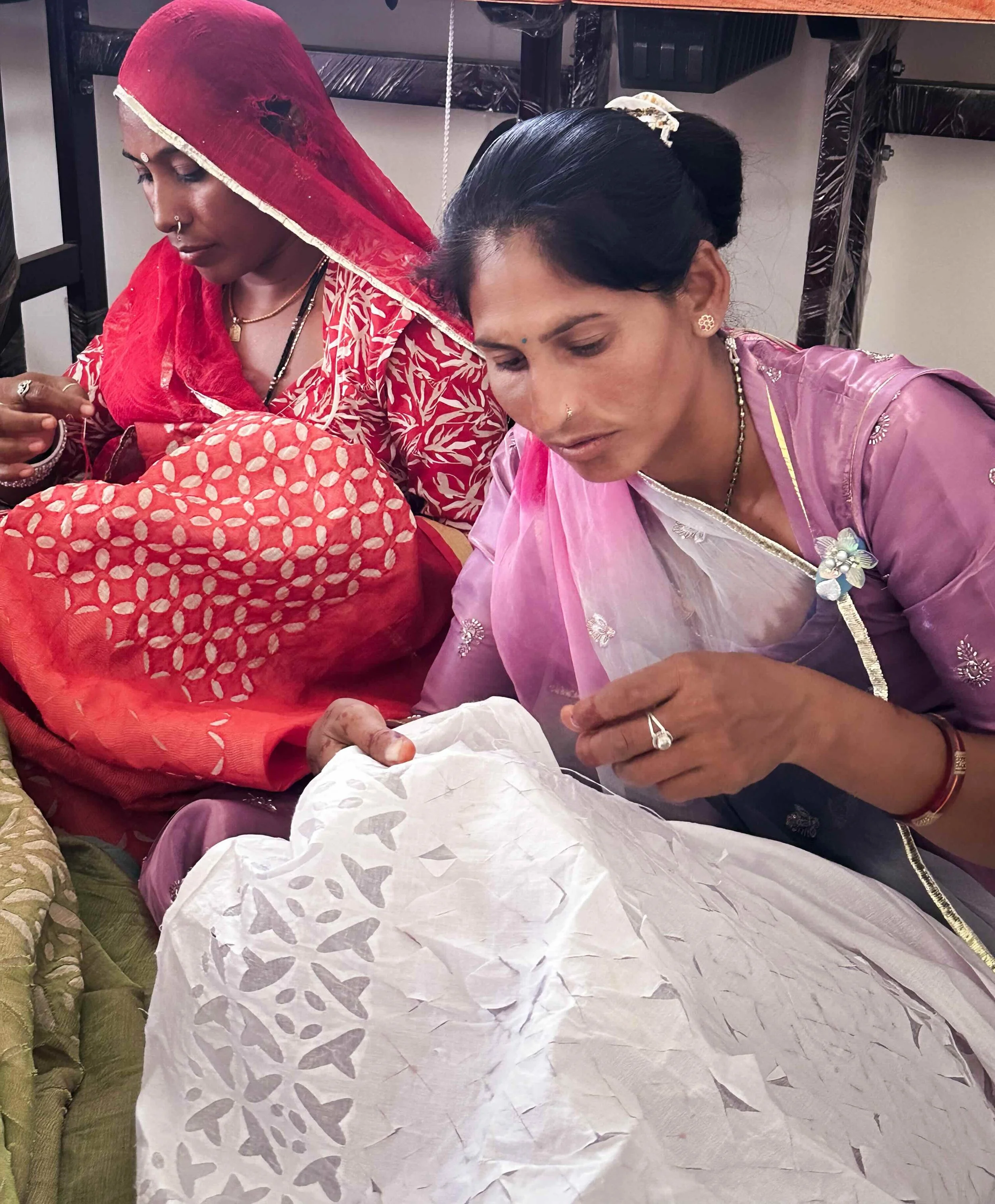
Hand stitching Katab cutwork at the Bhangta craft centre - precision work that cannot be done by machine.
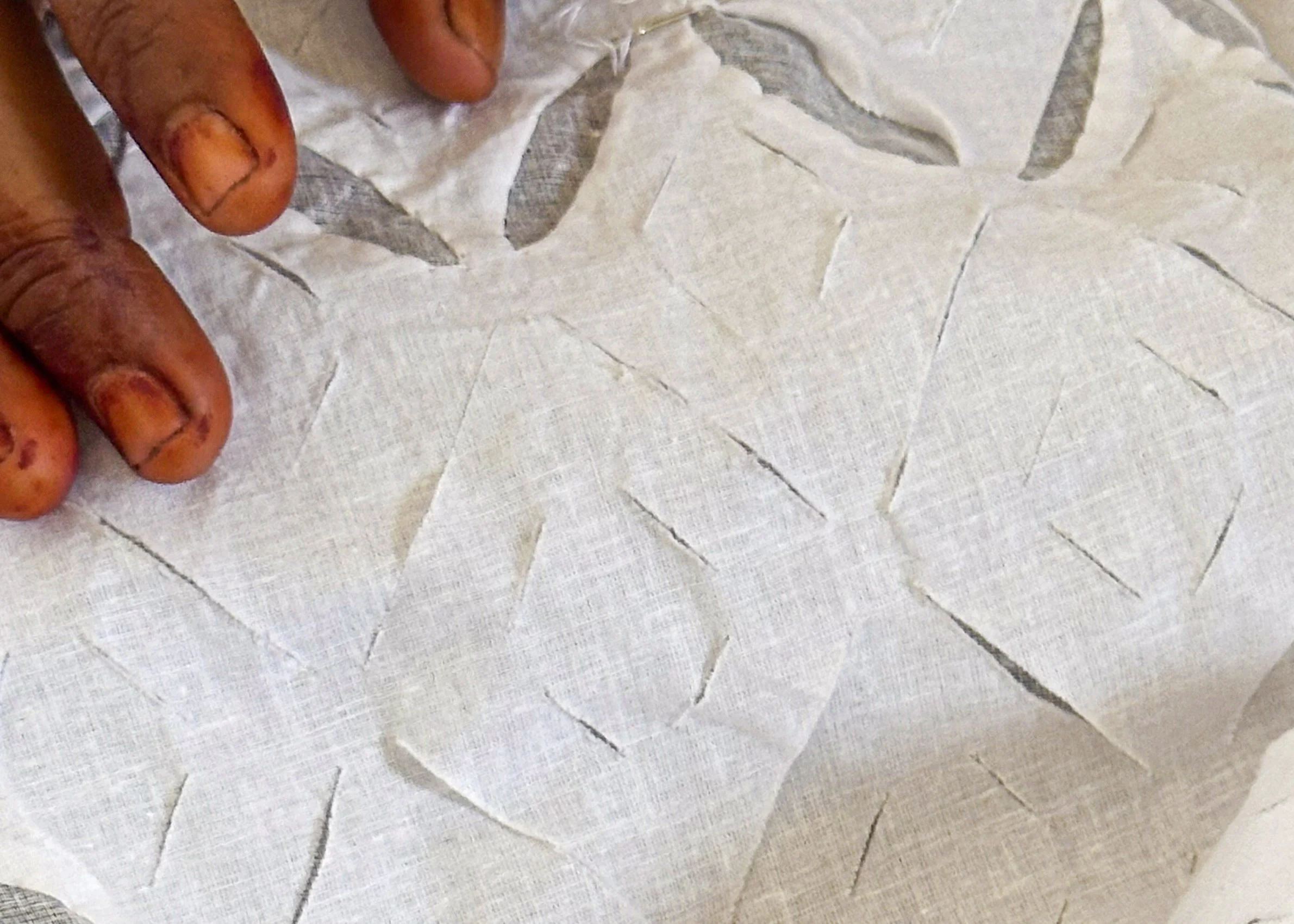
Katab cutwork on handwoven cotton, Bhangta, Barmer. A craft tradition originating in Sindh, brought to Rajasthan by families who settled here after Partition in 1947.
Fifteen Thousand Rupees and a Direction
I thought about what Ruma Devi had told me of those early years.
The first significant moment had come when she took the group’s work to an exhibition in Jaipur and this was her first taste of what was possible.
“She earned fifteen thousand rupees and that inspired her to work further creating homes for the women”, the translator said.
It sounds modest. In context it was transformative: proof that what rural women made with their hands had genuine value in a market they had never previously been able to reach. The obstacle was never skill. The women of Barmer had been embroidering and doing appliqué since childhood, from mirror work to cutwork, the intricate stitching that runs through the textile traditions of western Rajasthan like a continuous thread. What they lacked was access, to markets, to buyers, to the basic economic infrastructure that converts craft into income.
The hardest thing, she told me, was not the economics. It was the boundaries.
“The biggest problem for the women in this region is to break the boundaries of households. The society is mainly male and they dominate. It was very hard to break the boundaries at first. The rule was women should not go out to the cities or states alone. But now that is broken. Many families see the woman bringing in money. In the beginning it was very hard, but now families say: if women want to work with Ruma Devi, go.”
That shift from resistance to permission to active encouragement, took more than twenty years to build.
What She Has Built
Today, Ruma Devi leads two interconnected organisations: Gramin Vikas Evam Chetna Sansthan (GVCS), the rural development NGO whose showroom I had walked through that first morning, and the Ruma Devi Foundation, established in 2021. Together they have trained over fifty thousand rural artisan women across the Thar region, with more than thirty thousand currently active across 150 villages. Women trained in skills ranging from cutwork, appliqué, embroidery, and mirror work to tailoring, design, digital literacy, and the financial knowledge needed to trade independently.
The model is carefully structured. Artisan women sell directly through the foundation’s platform, rumadevi.com, with the foundation handling packaging, shipping, and logistics, ensuring the women receive a fair wage plus a share of profit.
“The problem with the middleman,” she said, with a directness that left no ambiguity, “is that they don’t get the artisans the fair value of their work. There are too many middlemen. I stand for the right of the artisans. Women are doing the work but not getting the profit.”
Her foundation does things differently. Artisan women working through the GVCS and rumadevi.com receive both a fair wage for their labour and a share of the profit from every sale.
Beyond craft, the foundation runs the Akshara scholarship programme for girls’ education; health camps covering eye care and menstrual hygiene; solar lighting for remote villages; and during Covid, organised oxygen, rations, and medical equipment for communities that had nothing. A multi-sports complex for rural girls is under construction. The craft generates the income.
At the GVCS compound in Barmer, alongside the showroom and workshop, a large poster advertises The Desert Story, a cultural performance Ruma Devi has created around the women’s craft traditions of the Thar. It is another piece of the same picture: she is not simply preserving craft. She is building an entire ecosystem around it.
She has received the Nari Shakti Puraskar, India’s highest civilian honour for women, presented by the President of India. She has spoken at Harvard. She lives in her village.
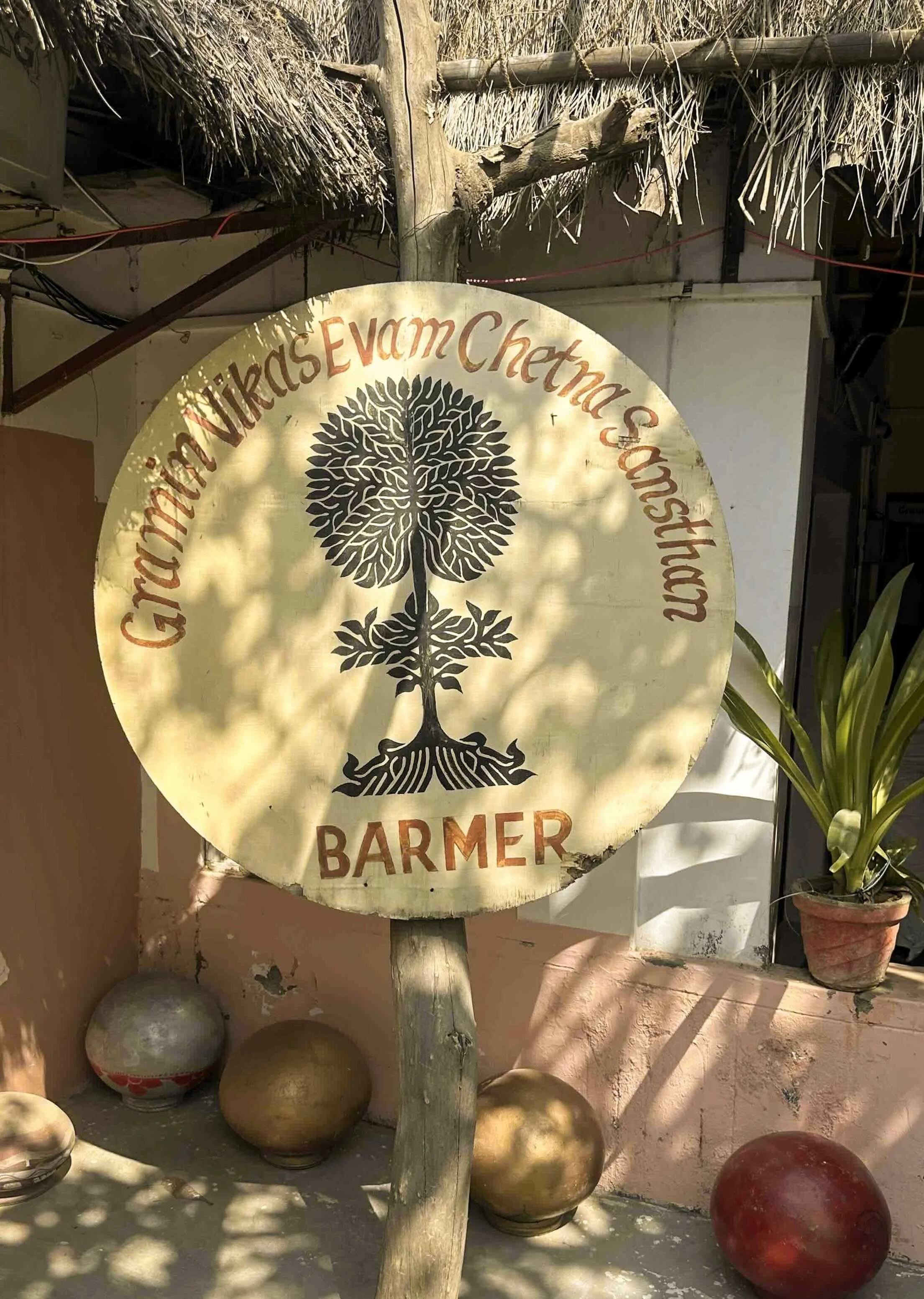
The entrance to the GVCS compound, Barmer - home of Ruma Devi’s organisation.
A Gift Hiding in Plain Sight
I have been sourcing textiles and working with artisan communities across India for thirty years. I know quality when I see it, and I know how the supply chain works.
The floors of the great textile warehouses in Jaipur and Jodhpur are full of Barmer work, appliqué bedspreads, cutwork, mirror work cushions, reverse appliqué curtains. I have bought from them for years. One long-established dealer in Jaipur, someone who has known me for decades, told me matter-of-factly that the work comes from factories near Barmer, women from the surrounding villages travelling in to stitch. He wasn’t ashamed. Why would he be? It is simply how the supply chain works. The women make it. The middlemen move it. The margins accumulate. By the time a bedspread reaches a warehouse floor in Jaipur, it has passed through several pairs of hands, none of them belonging to the woman who cut and stitched it.
Neither the GVCS showroom in Barmer nor the artisans’ collectives are on any buyer’s itinerary I am aware of, and that is a serious gap, for the buyers as much as for the artisans.
What is here is exceptional: katab cutwork in white, orange, and red; applique, patchwork, Heer Bharat hand embroidery; mirror work (shisha); woven textiles. All produced with a consistency and pride that comes from women who have been making these things since childhood and have now, finally, been given a structure that recognises and rewards what they do. There are no factories. No intermediaries taking a cut. The foundation handles logistics. The women do the work. The prices reflect actual labour and materials.
For designers and buyers with a serious interest in artisan production, for interiors companies sourcing handmade textiles, this is exactly the kind of direct relationship that is increasingly difficult to find anywhere in India.
Ruma Devi is open to working with international buyers. Her organisations run design and digital literacy programmes specifically so artisan women can understand and respond to international markets. She is not looking for charity. She is looking for buyers who will pay a fair price, and for people willing to fund exhibition costs, a lakh of rupees to show at a major national craft fair is beyond the reach of women earning at this level, but that kind of exposure is what brings the orders that change lives.
“They are not dependent on anyone. They can do it all by themselves. We want women to be entrepreneurs.”
Why This Matters
Ruma Devi has spent twenty years changing the material conditions of tens of thousands of other women’s lives by organising skills that already existed and a determination that was entirely her own.
The Nari Shakti Puraskar, the Harvard invitation, and the national recognition, are the incidental decorations of her story, not its substance. The substance is in the craft centre at Bhangta: forty women in a room, stitching, talking, laughing, wholly aware of their own capabilities. Several had never earned independent income before they walked through that door.
As we finished talking, she pressed a gift into my hands, a pink dupatta, cut and stitched by her women, the same work I had just spent an hour watching being made. It didn’t quite go with what I was wearing, but I treasured it immediately.
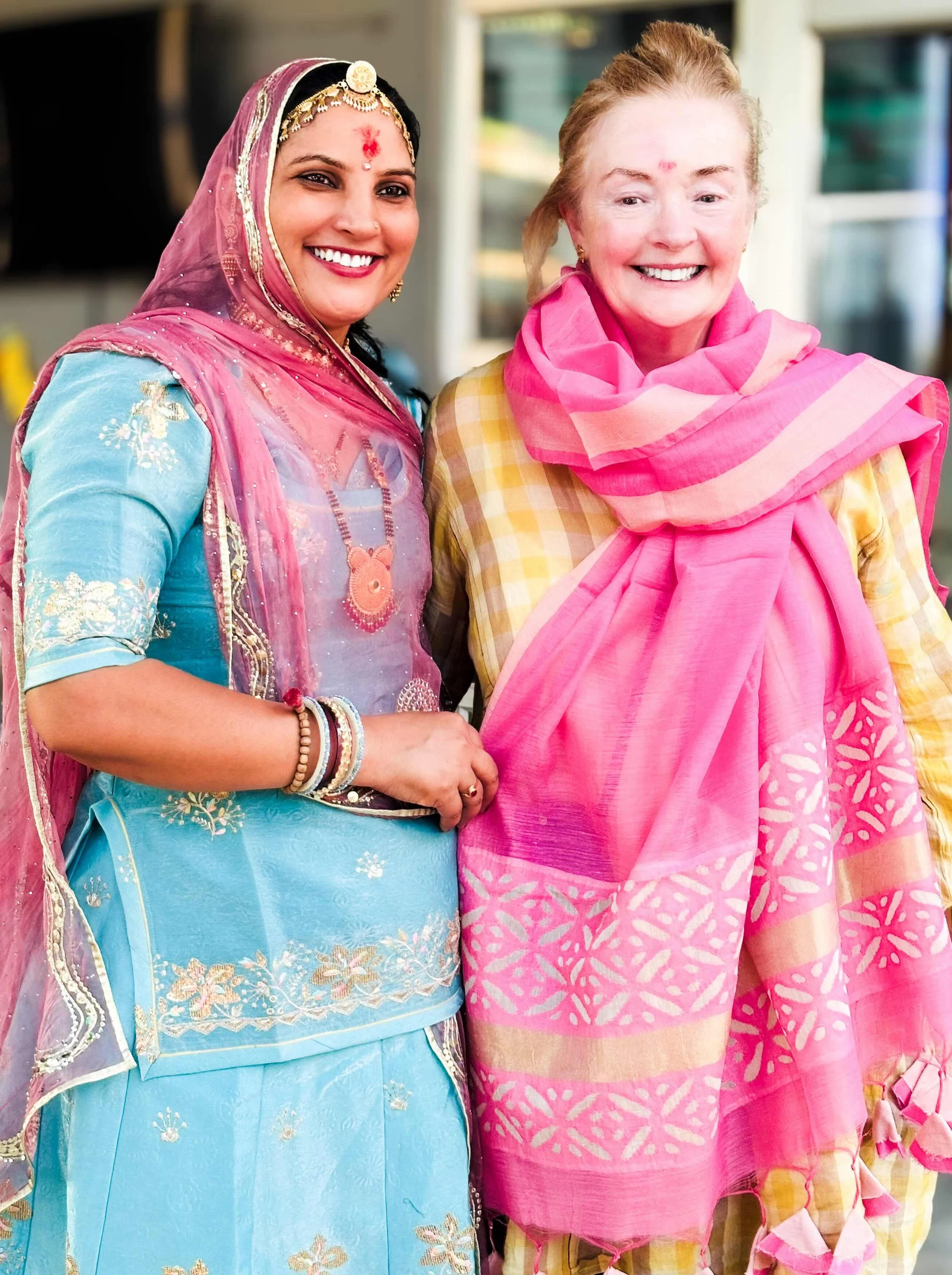
With Ruma Devi at the GVCS, Barmer, wearing the pink cutwork dupatta she gave me at the end of our interview.
One machine. One decision. A craft tradition brought back to life, and fifty thousand women who now know exactly what their work is worth.
If you would like to explore working with Ruma Devi’s artisans, as a buyer, designer, funder, or visitor, the foundation can be reached at rumadevi.com. I am also very happy to make a direct introduction.
Bernadette O’Farrell has spent thirty years working with artisan communities primarily in Rajasthan and Kerala. She leads small-group cultural and textile journeys for women through India with Bernadette.