

By Bernadette O’Farrell
I trace this particular obsession back to a single image - a photograph in a magazine, sometime in the late 1980s of a woman wrapped in an emerald green shawl, thickly embroidered in delicate flowers. I can’t remember who she was. I only remember the shawl.
A few months later, on my first trip to India, I walked into a shop off the lobby of the Taj in Mumbai and came face to face with the real thing. Rows of them. Featherlight cashmere in every depth of colour, their borders and bodies traced with embroidery so fine the needlework seemed almost to float on the surface. I looked at every single one. I couldn’t afford any of them. And that, as it turns out, was the beginning of a very long story.
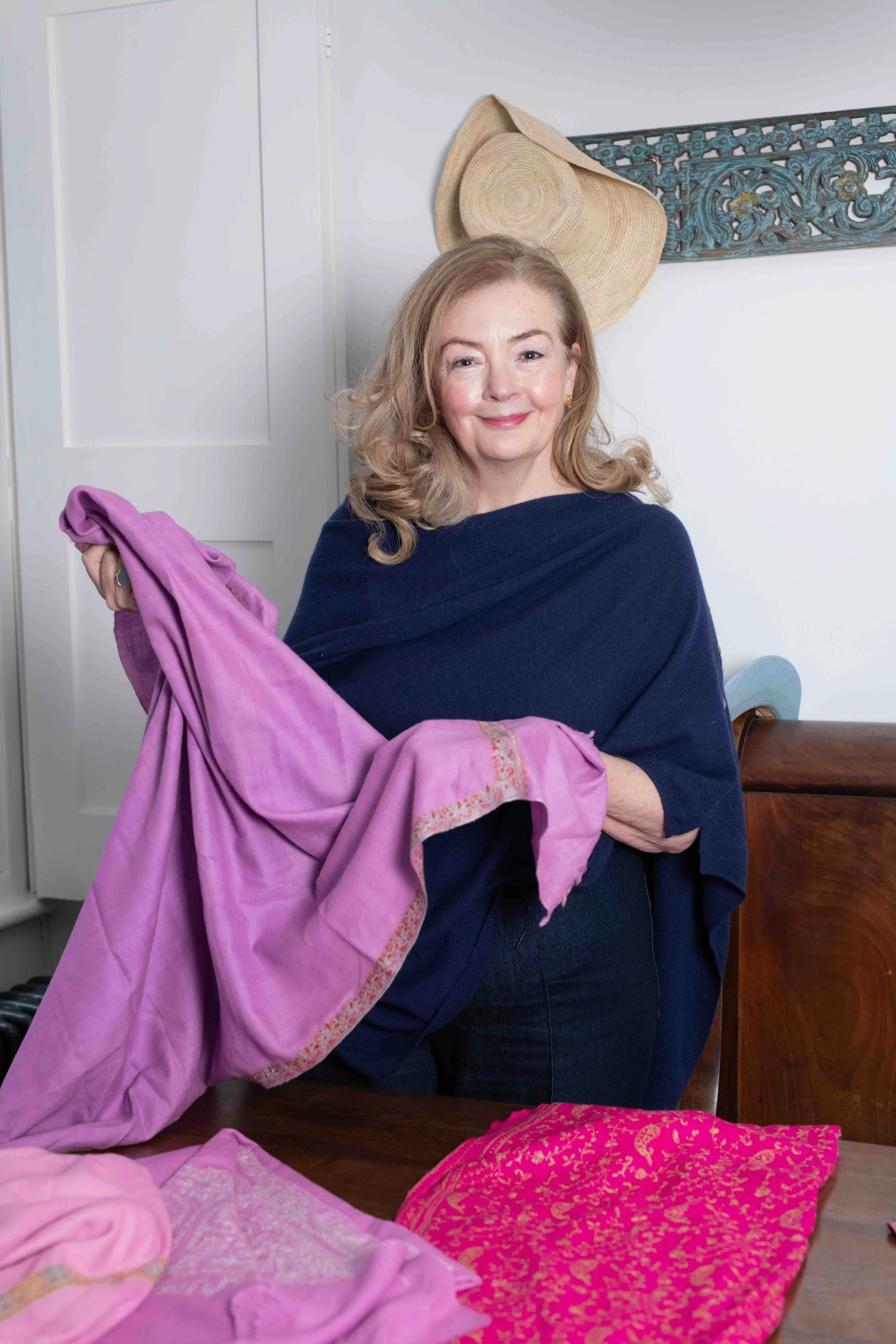
Kashmir Shawls
A few of the beautiful shawls I am lucky enough to own
Where Pashmina Begins
The wool that makes these shawls possible comes from one of the most inhospitable places on earth. The Changra goats of the Changthangi plateau in Ladakh live at altitudes where winters are severe enough to force the animals to grow a dense, extraordinarily fine undercoat - fibres measuring between 12 and 16 microns, finer than the finest merino. When summer comes, the herders of the Changpa tribe comb this fleece by hand, pack it into bales, and send it down to the Kashmir Valley, where it enters a months-long process of cleaning, spinning, weaving, and finally embroidery.
The spinning is done almost entirely by women, using a wheel called a yinder. The weaving happens in small family workshops - karkhanas - on handlooms. And then the embroidery begins. A fully embroidered Sozni shawl, where dense needlework in fine silk or wool thread covers most of the ground fabric, can take a single artisan the better part of a year. A particularly complex piece may take two or three. The result is something that functions less like a garment than like a manuscript. A record of sustained, concentrated skill and history.
Learning to Look
Over thirty-seven years of travel in India, I’ve bought shawls in bazaars and hotel corridors, from dealers in Jaipur and Srinagar, from men sitting cross-legged on the floor surrounded by shelves of cloth wrapped in layers of white muslin. The unwrapping is part of the ritual. There is no hurry. Each piece is lifted out, shaken open, held to the light. You feel the weight or the deliberate absence of it. You run a finger across the embroidery to feel whether it sits proud of the surface, as hand-stitched Sozni does, or lies flat in the way machine work tends to. You look at the reverse, which on a properly hand-embroidered shawl will be almost as neat as the front.
The Kashmiri shawl tradition encompasses several distinct embroidery styles. Sozni kari, a fine needlework so dense it can make the base fabric invisible, is the most painstaking and the most prized. Tilla work uses gold or silver metal thread and has its roots in Mughal court dress. Kani shawls are woven rather than embroidered, the pattern built into the fabric itself using a technique that produces a design identical on both faces. All of them beautiful. None of them are quick to make, and none of them are inexpensive if they are genuine.
Price is the most honest indicator. Authentic hand-embroidered pashmina starts at around ₹30,000 and rises steeply from there. If a shawl costs less, it is almost certainly not what it claims to be.
A fully embroidered shawl can take many months to complete; a particularly intricate piece, worked densely across the surface, may take a year or more in the hands of a single artisan.
The signature is usually worked into a corner, sometimes in a thread that sits slightly apart from the rest of the embroidery. There can be something almost incongruous about it, but I have come to value it. It is the quiet mark of the hand that made it.
I am not an expert in how they are made. What I have is years of looking, handling, and learning from those who are.
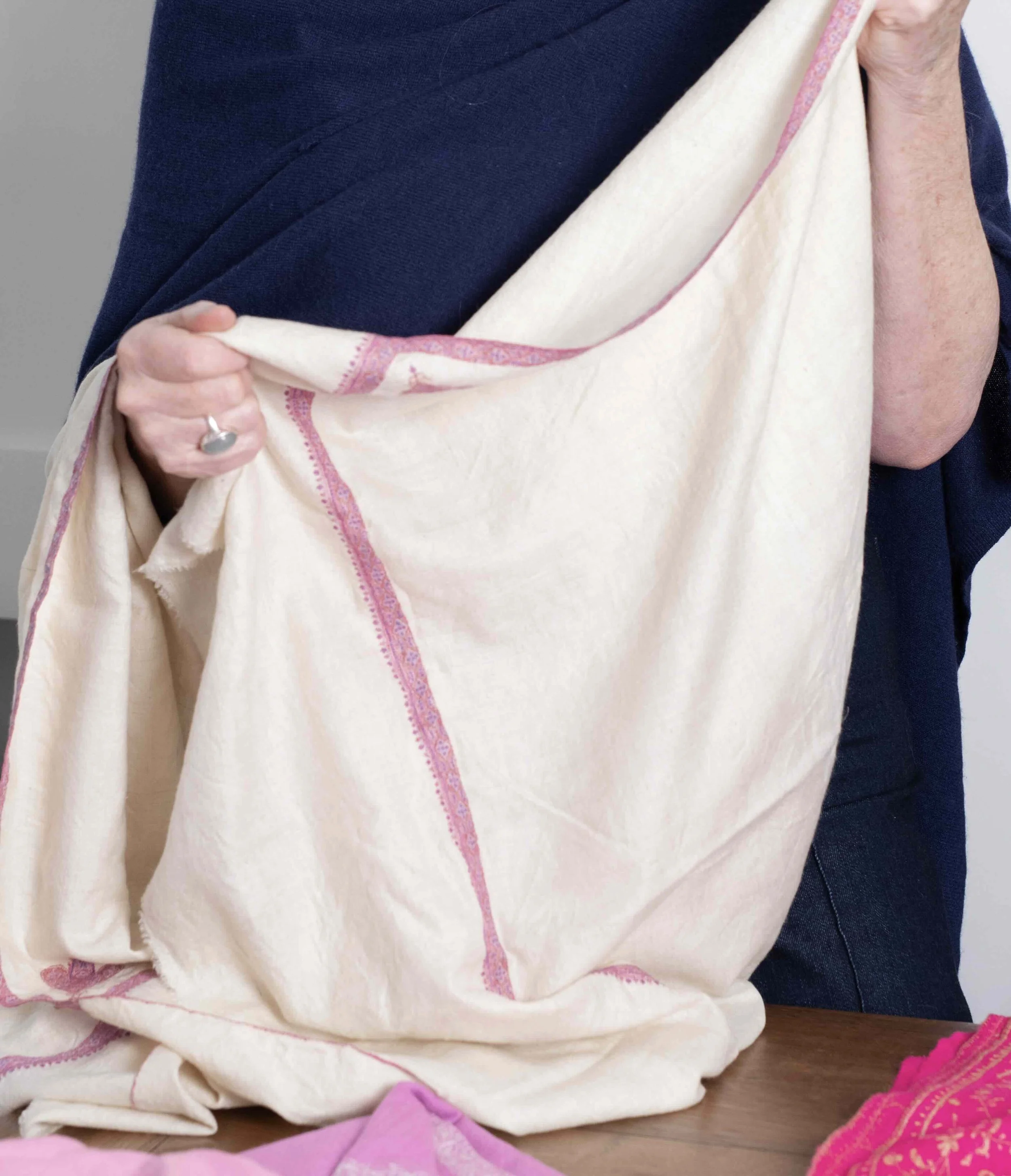
A fine Kashmiri shawl edged with delicate sozni embroidery, a line of tiny flowers worked patiently by hand.
Where to Find Them
In Delhi, I always make sure I stop off at Ahujasons, one of the oldest and most respected shawl houses in the city, a place where the stock is serious and the service unhurried. I favour the shop in Karol Bagh, on the Ajmal Khan Road. My tip is to ask to see the stoles ( smaller than shawls) and not as expensive. But be sure to allow lots of time and savour the experience. Ask to see their best pieces and ask then to explain about the different techniques and qualities.
Another must visit is Kashmir Loom, in Nizamudin East, founded by Jenny Housego and Asaf Ali, occupies a different position: their work reinterprets traditional Kani and Sozni techniques for a contemporary eye, producing pieces that sit comfortably alongside the best international textile design without abandoning their origins. Their work is jaw-dropping gorgeous. Colour, design and the softest of cashmere. I take guests from my tours to both. The contrast between them is instructive.
In Jaipur, Andraab is worth seeking out for the quality of its embroidered pieces. Just around the corner from Narain Niwas Palace, they offer a more intimate space than the Delhi shops, but the stock is carefully chosen and irresistible.
What these places share is a seriousness, passion and the most exquisite shawls. You will not be rushed. You will be shown things you can’t afford alongside things you can. And if you ask questions, about the embroidery technique, the wool, the provenance, you will get real answers.
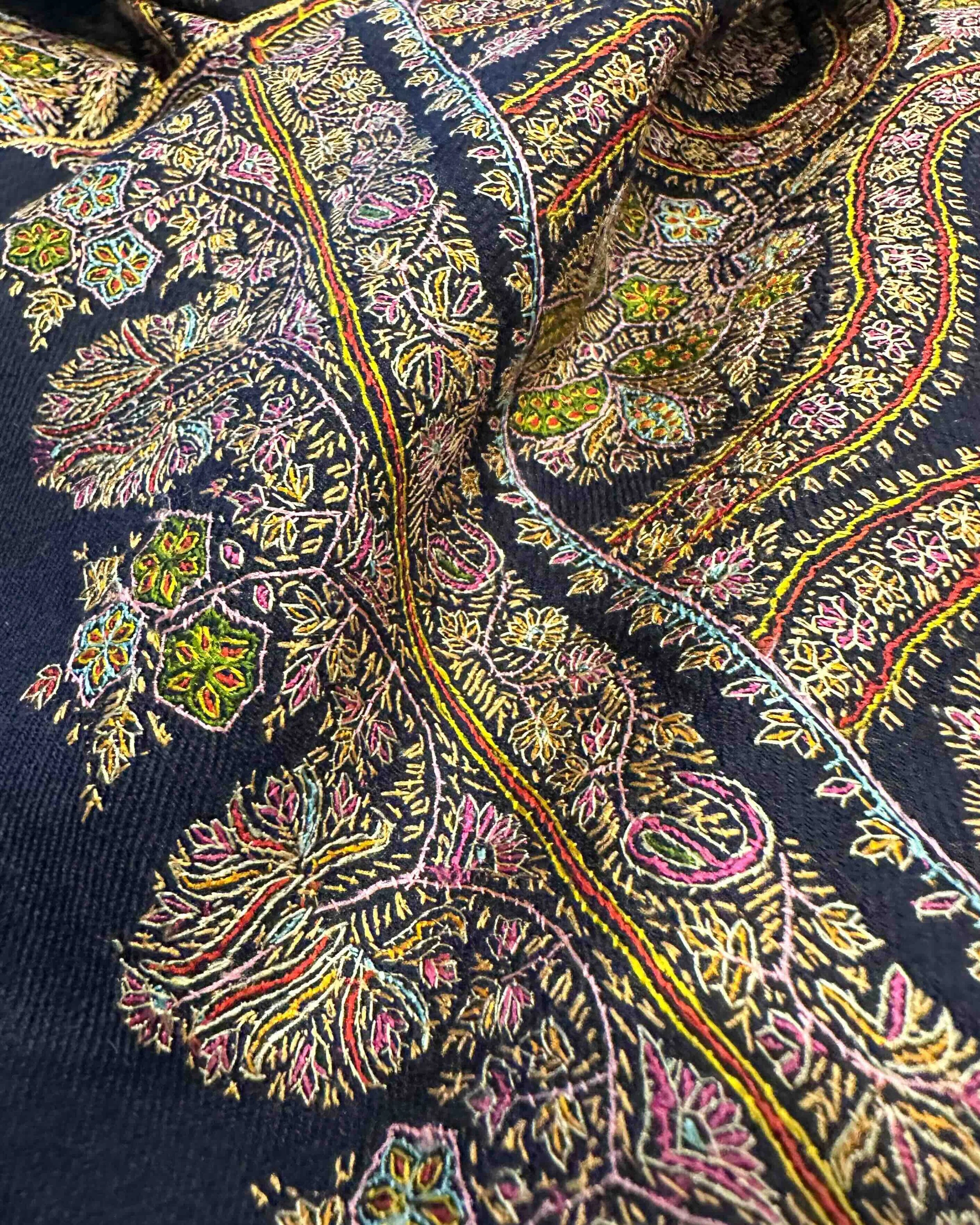
Fine Kashmiri hand embroidery in an all-over jaal of flowers and paisley, each stitch worked with extraordinary precision
What They Accumulate
I own more of these shawls than is entirely defensible. Some I bought at the height of my budget; others came to me more cheaply because I knew where to look and what to look for. A few have been passed on from dealers who understood that someone standing for forty minutes with a shawl in their hands was a serious buyer, not a browser.
What I’ve learned, mostly, is that the knowledge compounds. The more you handle the real thing, the more quickly you recognise what isn’t. The slightly synthetic sheen of a blended fibre. Embroidery that’s too even, too flat, too fast. A fringe that’s been cut rather than twisted. These aren’t mystical skills. They’re the result of paying attention over a long time.
A good Kashmiri shawl will outlast its owner. I often joke with my daughter that she will inherit shawls rather than jewellery. It is only half a joke.
I source embroidered cashmere shawls from Kashmir as part of my curation work for The Indian Garden Company, and I bring guests, if they wish, to visit trusted dealers during my journeys in Rajasthan and Delhi.
I would also like, at some point, to follow the journey of the fibre itself, from Ladakh through to Kashmir, and spend time with the people who work at each stage. It is not a simple thing to arrange, but if it is something that would interest you, I would be glad to hear.
And if you would like guidance on where to find and how to buy genuine pieces, I am always happy to help.
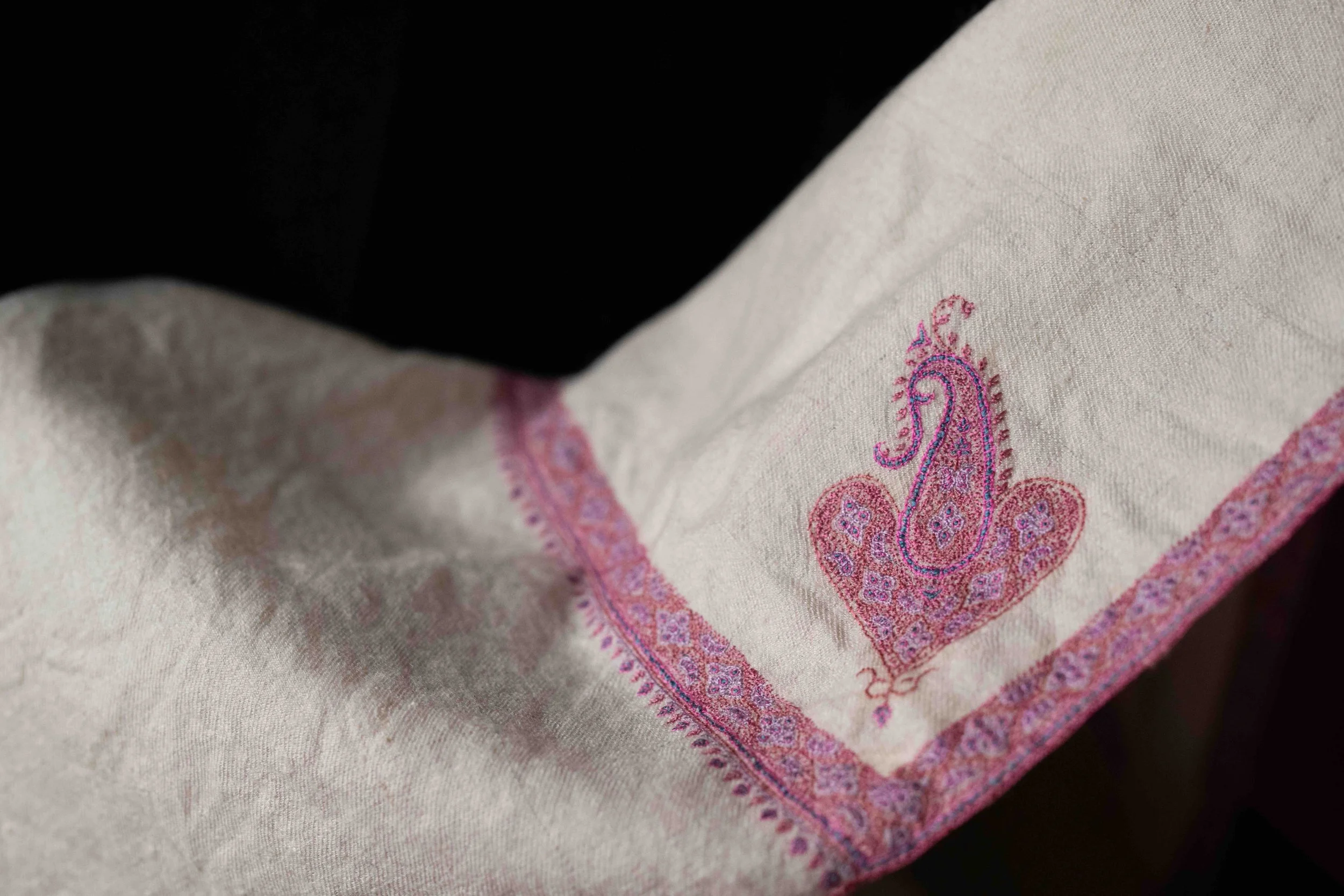
Fine needwork on a Kashmiri shawl.
Bernadette O’Farrell has spent thirty years working with artisan communities primarily in Rajasthan and Kerala. She leads small-group cultural and textile journeys for women through India with Bernadette.